• Home
  • Site Aliases
    • www.cloud-native.info
  • About
    • Background
    • Presenting Activities
    • Internet Profile
      • LinkedIn
    • About
  • Books & Publications
    • Log Generator
    • Logs and Telemetry using Fluent Bit
      • Fluent Bit book
      • Book Resources in GitHub
      • Fluent Bit Classic to YAML Format configurations
    • Logging in Action with Fluentd, Kubernetes and More
      • Logging in Action with Fluentd – Book
      • Fluentd Book Resources
      • Fluentd & Fluent Bit Additional stuff
    • API & API Platform
      • API Useful Resources
    • Oracle Integration
      • Book Website
      • Useful Reading Sources
    • Publication Contributions
  • Resources
    • GitHub
    • Oracle Integration Site
    • Oracle Resources
    • Mindmaps Index
    • Useful Tech Resources
      • Fluentd & Fluent Bit Additional stuff
      • Recommended Tech Podcasts
      • Official Sources for Product Logos
      • Java and Graal Useful Links
      • Python Setup & related stuff
      • DevTips
  • Music
    • Monster On Music
    • Music Listening
    • Music Reading

Phil (aka MP3Monster)'s Blog

~ from Technology to Music

Phil (aka MP3Monster)'s Blog

Category Archives: Fluent Observability

Covers all the observability considerations

Securing credentials in Fluentd configurations

07 Tuesday Jun 2022

Posted by mp3monster in development, Fluentd, General, manning, Technology

≈ Leave a comment

Tags

Conjur, env vars, environment variables, Fluentd, Hashicorp, open source, Ruby, secrets, Security, slack, token, Vault

When configuring Fluentd we often need to provide credentials to access event sources, targets, and associated services such as notification tools like Slack and PagerDuty. The challenge is that we don’t want the credentials to be in clear text in the Fluentd configuration.

Using Env Vars

In the Logging In Action with Fluentd book, we illustrated how we can take the sensitive values from environment variables so the values don’t show up in the configuration file. But, we’ve seen regularly the question of how secure is this, can’t the environment variable be seen by everyone on that machine?

The answer to this question comes down to having a deeper understanding of how environment variables work. There is a really good explanation here. The long and short of it is that environment variables can only be seen by the process that creates the variable and any child process will receive a copy of the parent’s variables.

This means that if we create the variable in a shell, only that shell and any processes launched by that shell can see the environment variable. So as long as we don’t set variables up as part of a system-level configuration then we already have a level of security. So we could wrap the start of Fluentd with a script that sets the environment variables needed. Then everything launches that script.

An even better way?

Continue reading →

Share this:

  • Share on Facebook (Opens in new window) Facebook
  • Share on X (Opens in new window) X
  • Share on Reddit (Opens in new window) Reddit
  • Email a link to a friend (Opens in new window) Email
  • Share on WhatsApp (Opens in new window) WhatsApp
  • Print (Opens in new window) Print
  • Share on Tumblr (Opens in new window) Tumblr
  • Share on Mastodon (Opens in new window) Mastodon
  • Share on Pinterest (Opens in new window) Pinterest
  • More
  • Share on Bluesky (Opens in new window) Bluesky
  • Share on LinkedIn (Opens in new window) LinkedIn
Like Loading...

Coding over Cocktails with Fluentd

06 Friday May 2022

Posted by mp3monster in Books, Fluentd, General, manning, Podcasts, Technology

≈ Leave a comment

Tags

book, Coding over Cocktails, Logging in Action, podcast, Toro Cloud

I’ve been fortunate enough to appear on a podcast with the excellent Coding Over Cocktails team from Toro Cloud. we got to talk about some of the ideas discussed in my Logging In Action book. You can check the podcast out via their website which includes all the episode details and links to all the platforms that host the podcast. There have been some great previous guests such as Luis Weir (my old boss), Chris Richardson of Microservices.io, Matthew Reinbold from Postman, Sam Newman to name just a few.

Share this:

  • Share on Facebook (Opens in new window) Facebook
  • Share on X (Opens in new window) X
  • Share on Reddit (Opens in new window) Reddit
  • Email a link to a friend (Opens in new window) Email
  • Share on WhatsApp (Opens in new window) WhatsApp
  • Print (Opens in new window) Print
  • Share on Tumblr (Opens in new window) Tumblr
  • Share on Mastodon (Opens in new window) Mastodon
  • Share on Pinterest (Opens in new window) Pinterest
  • More
  • Share on Bluesky (Opens in new window) Bluesky
  • Share on LinkedIn (Opens in new window) LinkedIn
Like Loading...

Handling multi-line log entries with Fluentd

19 Tuesday Apr 2022

Posted by mp3monster in Books, Fluentd, General, logsimulator, manning, Technology

≈ Leave a comment

Tags

book, Fluentd, multiline, parser, regex

One aspect of logging I didn’t directly address with my Fluentd book was consuming multiline logs, such as those you’ll often see when a stack trace is included in the log output. Implementing the feature with Fluentd isn’t hugely complex as it leverages the use of regular expressions (addressed in the book in more depth) to recognize the 1st line in a multiline log entry and for subsequent lines.

I didn’t address it for a couple of reasons:

  • Using parsers is fairly inefficient, particularly when you’re using a parser to just decide how to then transform a line (this is why I’m not a huge fan of some of the 12 Factor App‘s recommendations when it comes to logging).
  • Incorporating into your Fluentd parser configurations for specific app log setups is arguably increasing the level of coupling.
  • Many logging frameworks can talk directly to Fluentd as we saw in the book. This is can be more efficient, which means that the log event is more likely to be passed over in a structured format (therefore less work to do).
  • Alternatively, frameworks like Log4J2 have the means to strip line feeds, etc at source – https://logging.apache.org/log4j/2.x/manual/layouts.html (see replace)

But let’s also be realistic, many applications will be configured to simply log to a file and aren’t likely to be changed. At which point we do need to process such situations, so is it done? The process remains largely the same as the tail plugin we illustrated. Except we introduce a different parser called multiline. The documentation provided by Fluentd includes several examples of multiline configurations that will work for default log formats (such as Log4J and Rails). If we took our most basic source setup:

<source>
  @type tail
  path ./Chapter3/basic-file.*
  read_lines_limit 5
  tag simpleFile
  <parse>
    @type none
  </parse>
</source>

Then assuming our log Simulator played back multiline logs (the provided configuration doesn’t do that) extended to consume standard Log4J2 logs we would have a configuration as follows:

<source>
  @type tail
  path ./Chapter3/basic-file.*
  read_lines_limit 5
  tag simpleFile
  <parse>
     @type multiline
     format_firstline /\d{4}-\d{1,2}-\d{1,2}/
     format1 /^(?<time>\d{4}-\d{1,2}-\d{1,2} \d{1,2}:\d{1,2}:\d{1,2}) \[(?<thread>.*)\] (?<level>[^\s]+)(?<message>.*)/
  </parse>
</source>

As you can see we’ve set the parser type to multiline. Then there are two regular expressions, format_firstline is used to help recognize the start of a log event. Every line of the log is tested with this expression as we now assume unless this produces a valid result that the line will be part of a multiline event. If you look at the expression you’ll realize it is looking for a DateTime stamp in the form YYYY-MM-DD. This does mean if you generate a log that starts with the date even if it is part of a multiline output then you’ll trip up the parser. You could extend the expression – but the longer it is the slower the processing.

Following format_firstline we have in our example format1 which describes how to process the first line. This can be extended to define how to handle subsequent lines but this could be multiple format definitions. They do need to be presented in numerical order eg. format1, format2, format, and so on.

LogSimulator – Playing back multi-line logs

The Log simulator uses a very similar mechanism to Fluentd to understand how to playback multiple line logs. When it is reading the log lines in for replay it uses a regular expression to recognize the start of a new log entry (FIRSTOFMULTILINEREGEX) defined in the properties file. The simulator will concatenate lines together until it either hits the end of the file or has a new line that complies with the REGEX. It stores the line with an encoded /n (newline character). It will then print the log using the format specified and will allow the /n to create a newline (or not) based on another config parameter (ALLOWNL).

Share this:

  • Share on Facebook (Opens in new window) Facebook
  • Share on X (Opens in new window) X
  • Share on Reddit (Opens in new window) Reddit
  • Email a link to a friend (Opens in new window) Email
  • Share on WhatsApp (Opens in new window) WhatsApp
  • Print (Opens in new window) Print
  • Share on Tumblr (Opens in new window) Tumblr
  • Share on Mastodon (Opens in new window) Mastodon
  • Share on Pinterest (Opens in new window) Pinterest
  • More
  • Share on Bluesky (Opens in new window) Bluesky
  • Share on LinkedIn (Opens in new window) LinkedIn
Like Loading...

Avoid creating an event storm when using social outputs with Fluentd

14 Thursday Apr 2022

Posted by mp3monster in Fluentd, General, Technology

≈ Leave a comment

Tags

Fluentd, logging, mail storm, monitoring, Plugin, social, supress

Fluentd has an incredible catalogue of plugins including notification and collaboration channels from good old-fashioned email through to slack, teams, and others.

The thing to remember if you use these channels is that if you’re sending errors, from application logs it isn’t unusual for there to be multiple error events as a root event can cause a cascade of related issues. For example, if your code is writing transactions to a database and the database goes down with no failover mechanism, then your code will most likely experience an error, roll back the transaction perhaps to some sort of queue, and then try to process the next event. Which will again fail. This is the classic situation where multiple errors will get reported for the same issue. This problem is often referred to as a mail storm given that there was a time when we didn’t have social collaboration tools and everyone used email.

There are several ways to overcome this problem. But the most simple and elegant of these is using the suppress plugin in its filter mode.

<filter **>
  @type suppress
  interval 60       # period in seconds when the condition to supress is triggered
  num 2             # number of occurences of a value before suppressing
  attr_keys source  # the element of the event to consider.
</filter>

In this example if we encounter an event with an attribute called source containing the same value twice then the suppression will kick in for 60 seconds. If you want the key to the valuebeing checked to be the tag then simply omit the attr_keys parameter.

Of course, we don’t want the suppression to kick in if the same value in the attribute keys occured once every few hours. To address this the occurence count is applied over not a time period, but a number of events received by the configuration of max_slot_num which defaults to 10k, but resets

In the filter mode, this plugin is best positionbed immediately before the match block. This means we don’t accidentally suppress messages before they are routed anywhere else.

For the purposes of a demo this is less of an issue. But for a realworld use case would probably benefit from some tuning. All the documentation for this plugin is at https://github.com/fujiwara/fluent-plugin-suppress

Share this:

  • Share on Facebook (Opens in new window) Facebook
  • Share on X (Opens in new window) X
  • Share on Reddit (Opens in new window) Reddit
  • Email a link to a friend (Opens in new window) Email
  • Share on WhatsApp (Opens in new window) WhatsApp
  • Print (Opens in new window) Print
  • Share on Tumblr (Opens in new window) Tumblr
  • Share on Mastodon (Opens in new window) Mastodon
  • Share on Pinterest (Opens in new window) Pinterest
  • More
  • Share on Bluesky (Opens in new window) Bluesky
  • Share on LinkedIn (Opens in new window) LinkedIn
Like Loading...

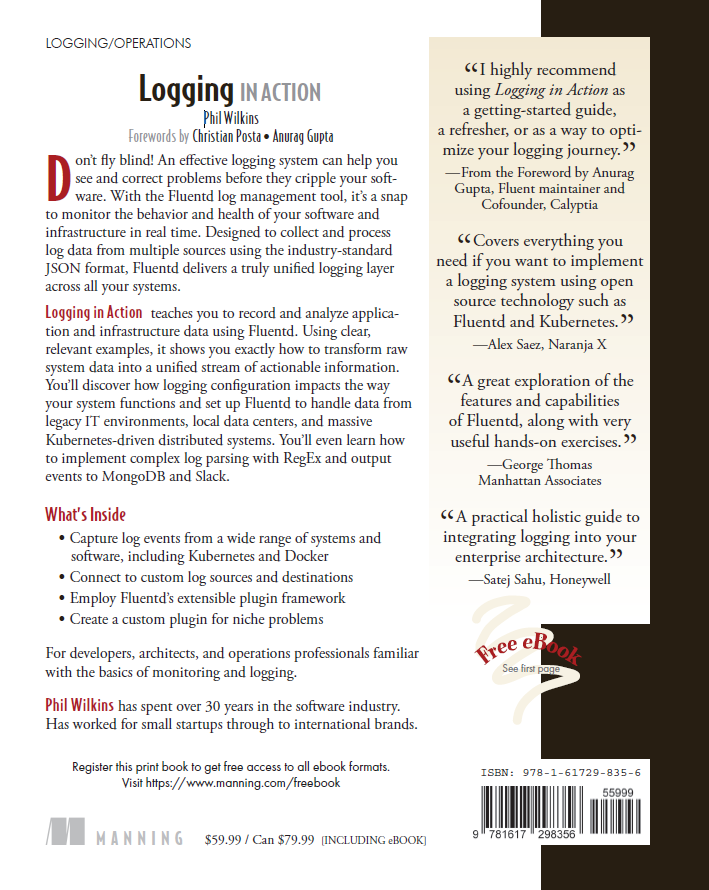
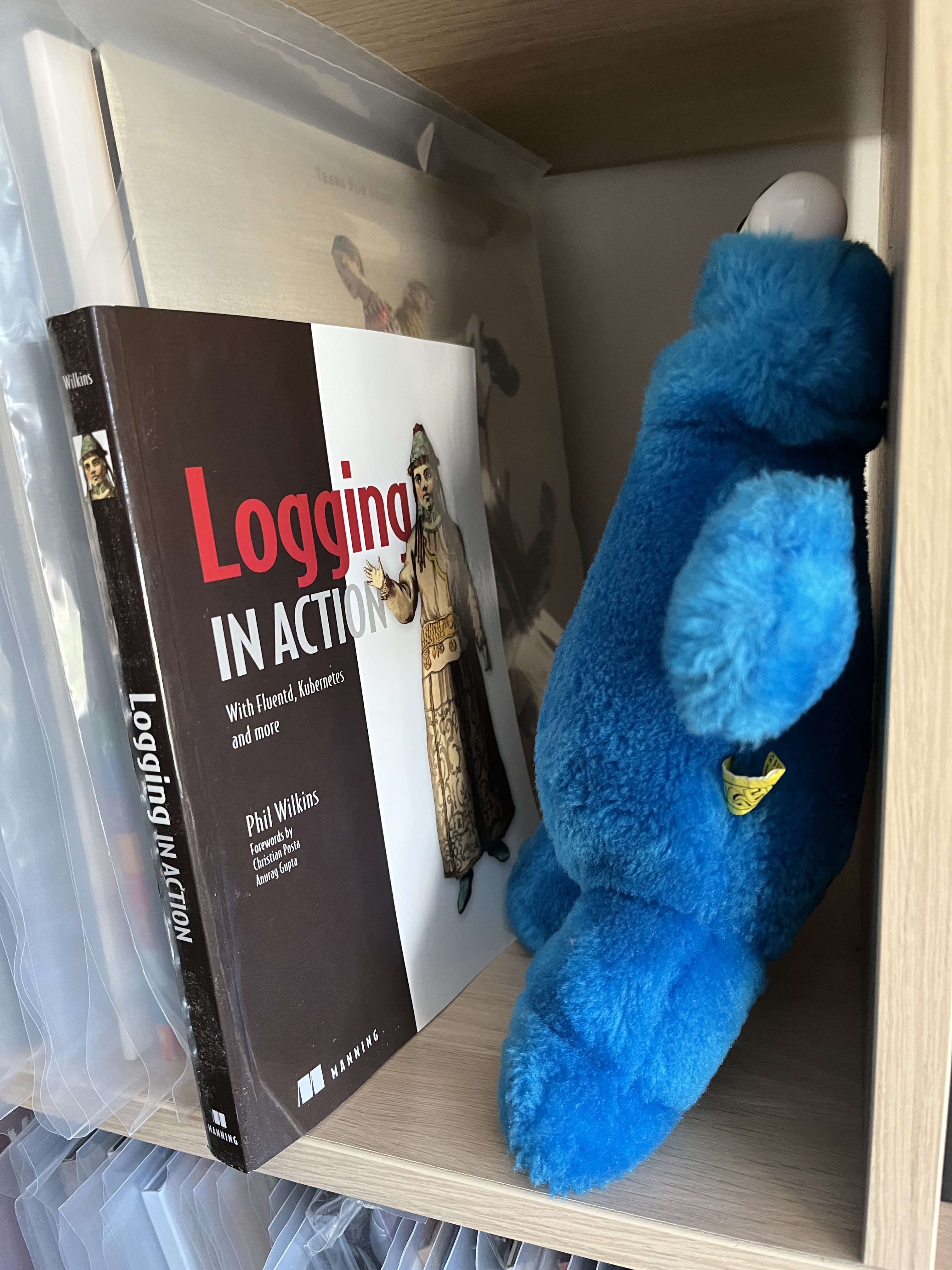
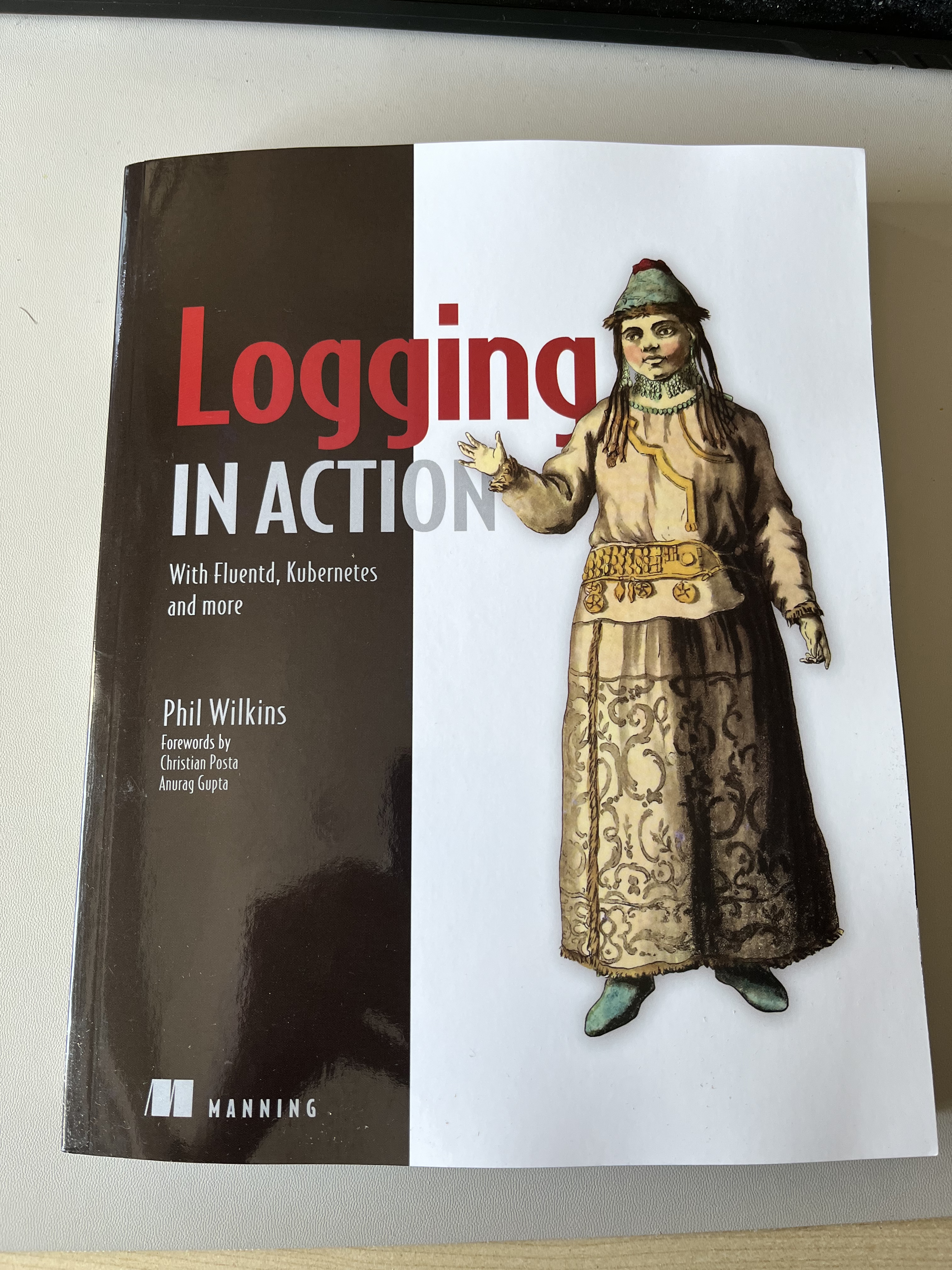
Logging in Action – has gone to the printers!

07 Monday Feb 2022

Posted by mp3monster in Books, Fluentd, General, manning, Technology

≈ 1 Comment

Tags

Amazon, Barnes & Noble, book, logging, Logging in Action, manning, print, Waterstones

The final leg of getting the book published has taken a lot longer than had been expected. But we’ve just been told that the book has been sent to the printers. This means:

  • final eBook will be available from Manning in about 1 week
  • Preordered print copies of the book will be dispatched in about 2 weeks
  • The alternative ebook formats for mobile readers e.g. kindle etc available in about 3 weeks
  • The book will become available to purchase from other book stores such as
    Amazon in 3-4 weeks
  • Safari Books Online and Apple stores will have the ebook in 4-5 weeks

Here are some links for buying the book …

  • Manning
  • Amazon UK – Amazon US – Amazon DE – Amazon Fr
  • Barnes & Noble, Waterstones
  • Safari Online Books

It also means the project from a writing perspective is complete. But we’re starting to look at the additional examples we’ll add to the GitHub repo. These will be dependent upon the book.

The complete cover artworks …

We’ve got print books now …

Share this:

  • Share on Facebook (Opens in new window) Facebook
  • Share on X (Opens in new window) X
  • Share on Reddit (Opens in new window) Reddit
  • Email a link to a friend (Opens in new window) Email
  • Share on WhatsApp (Opens in new window) WhatsApp
  • Print (Opens in new window) Print
  • Share on Tumblr (Opens in new window) Tumblr
  • Share on Mastodon (Opens in new window) Mastodon
  • Share on Pinterest (Opens in new window) Pinterest
  • More
  • Share on Bluesky (Opens in new window) Bluesky
  • Share on LinkedIn (Opens in new window) LinkedIn
Like Loading...

LogSimulator new features

03 Friday Sep 2021

Posted by mp3monster in development, Fluentd, General, logsimulator, Technology

≈ Leave a comment

Tags

Log, logging, tool, utility

The log simulator we’ve built and written about in the past has had a release made that lines up with the Logging In Action book (v0.1). I am now continuing to add improvements on the main line. Not best Git branching practice, but as I’m working on this solo it doesn’t represent a problem.

If you expect multi line events all you need to do, is add to the properties file a name value pair, with the name FIRSTOFMULTILINEREGEX and the value is a Java/Groovy regular expression which can be used to determine if a line in a log entry is the 1st line in a new log. Then all subsequent log lines are appended to the previous line until a line identifies as a new log entry. The log entry will be written with newline characters in the same place as the read.

In addition to this if the synthetic log events need to be set to be new line then using the ALLOWNL property to be set to true will result in any new line escape sequences (\n) to be made into proper new lines in the output.

The details are all included in the documentation in GitHub.

Continue reading →

Share this:

  • Share on Facebook (Opens in new window) Facebook
  • Share on X (Opens in new window) X
  • Share on Reddit (Opens in new window) Reddit
  • Email a link to a friend (Opens in new window) Email
  • Share on WhatsApp (Opens in new window) WhatsApp
  • Print (Opens in new window) Print
  • Share on Tumblr (Opens in new window) Tumblr
  • Share on Mastodon (Opens in new window) Mastodon
  • Share on Pinterest (Opens in new window) Pinterest
  • More
  • Share on Bluesky (Opens in new window) Bluesky
  • Share on LinkedIn (Opens in new window) LinkedIn
Like Loading...

New and coming to a screen near you soon

31 Monday May 2021

Posted by mp3monster in Books, Fluentd, General, manning, Oracle, Technology

≈ Leave a comment

Tags

API, Fluentd, logging, Logging in Action, OCI, Oracle, OraWorld

Last night saw the final chapter of Logging in Action with Fluentd go back to my editor. The next step is that Chapter (and others I hope) will go to MEAP, so early readers not only get the final chapter, but also the raft of improvements we’ve made. Along with that, the manuscript goes for a full peers review. Once that’s back, its time for a round of edits as I address the feedback then into copy editing and Manning sign off review.

As you might have guessed, we’ve kept busy with an article in the 25th edition of OraWorld. This follows Part 1 talking about GraphQL with a look at considerations for API Security.

In addition to that we’re working on a piece around automation of OCI management activities such as setting up developers, allowing them a level of freedom to experiment without accidentally burning through all your credits by spinning up Exadata servers or 500 node Kubernetes clusters.

We might even have some time to write more about APIs and integration.

Share this:

  • Share on Facebook (Opens in new window) Facebook
  • Share on X (Opens in new window) X
  • Share on Reddit (Opens in new window) Reddit
  • Email a link to a friend (Opens in new window) Email
  • Share on WhatsApp (Opens in new window) WhatsApp
  • Print (Opens in new window) Print
  • Share on Tumblr (Opens in new window) Tumblr
  • Share on Mastodon (Opens in new window) Mastodon
  • Share on Pinterest (Opens in new window) Pinterest
  • More
  • Share on Bluesky (Opens in new window) Bluesky
  • Share on LinkedIn (Opens in new window) LinkedIn
Like Loading...

Unified Logging with Fluentd becomes Logging in Action using Fluentd, Kubernetes and more

08 Monday Feb 2021

Posted by mp3monster in Books, Fluentd, General, manning, Technology

≈ Leave a comment

Tags

book, Fluentd, In Action, Kubernetes, manning, progress

The book has had a title change as Manning found that links the book was clashing with other solutions using the term ‘Unified Logging’. With the name change it helps bring the book inline with the Manning naming with their In action series. This means the book website is now https://www.manning.com/books/logging-in-action.

With the name change we’ve agreed that there should an additional chapter added. As I’d written the book with a view that everything we cover applies to both modern solutions such as Microservices coming from the CNCF camp but equally relevant to more traditional IT landscapes. Within the book we have explianed how things are positioned and can be used in Kubernetes, but it was agreed with our editorial team that not tackling the configuration of Fluentd with Kubernetes and Docker was to an extent ignoring a key community that will be using Fluentd. So the new chapter will be introduced to address this aspect.

In terms of progress we’re into the 1’s – 1 Chapter to start (the new one), 1 Chapter back from the Technical Editor (Logging Best Practises) – some edits to be done, 1 Chapter now with the editor (How To Create Custom Plugins), 1 Chapter being finished (Logging Frameworks) and finally 1 peer review cycle to go.

Given the lovely review comments that have been quoted on the book’s page. I can only recommend if you have an interest in logging and monitoring then check it out through Manning Early Access Programme (MEAP).

Share this:

  • Share on Facebook (Opens in new window) Facebook
  • Share on X (Opens in new window) X
  • Share on Reddit (Opens in new window) Reddit
  • Email a link to a friend (Opens in new window) Email
  • Share on WhatsApp (Opens in new window) WhatsApp
  • Print (Opens in new window) Print
  • Share on Tumblr (Opens in new window) Tumblr
  • Share on Mastodon (Opens in new window) Mastodon
  • Share on Pinterest (Opens in new window) Pinterest
  • More
  • Share on Bluesky (Opens in new window) Bluesky
  • Share on LinkedIn (Opens in new window) LinkedIn
Like Loading...

Adventures in DevOps – Fluentd

20 Wednesday Jan 2021

Posted by mp3monster in Fluentd, General, Podcasts, Technology

≈ Leave a comment

Tags

Adventures In DevOps, Blueprint LDN, conference, manning, podcast, speaker, speaking, virtual, virtual event

I was fortunate enough to record a podcast with the team at Adventures In Dev Ops just before Christmas. The recording has been fine tuned and now available on their web site here. From my perspective, the discussion was really interesting and explored a wide range of areas around the challenges of monitoring.

As the podcast is linked to the book we’re writing for Manning (Unified Logging With Fluentd), there is a discount code currently running – poddevopsadv20.

Thanks to Charles Wood and Jeffrey Groman for having me on as a guest.

Other news …

I will be presenting at the online conference Blueprint LDN, check out the subjects being covered, looks very interesting.

Share this:

  • Share on Facebook (Opens in new window) Facebook
  • Share on X (Opens in new window) X
  • Share on Reddit (Opens in new window) Reddit
  • Email a link to a friend (Opens in new window) Email
  • Share on WhatsApp (Opens in new window) WhatsApp
  • Print (Opens in new window) Print
  • Share on Tumblr (Opens in new window) Tumblr
  • Share on Mastodon (Opens in new window) Mastodon
  • Share on Pinterest (Opens in new window) Pinterest
  • More
  • Share on Bluesky (Opens in new window) Bluesky
  • Share on LinkedIn (Opens in new window) LinkedIn
Like Loading...

Latest on book and APIs

15 Tuesday Dec 2020

Posted by mp3monster in Books, Fluentd, General, manning, Technology

≈ 1 Comment

Tags

AdeventuresInDevOps, book, development, Fluentd, manning, MEAP, podcast, Redis, unified logging

My blogging is way down compared with only a post about OKit – OCI Design (on Windows). It largely comes down to lots of work on our Fluentd book. Chapter 6 is now available in the MEAP. As the promo info says …

What’s new?

Chapter 6, “Filtering and Extrapolation”

Gain control and insight!

Last chapter, we touched on the use of the Filter directive. But that was just the tip of the iceberg! In Chapter 6, we’ll plunge below the surface, exploring the when, why, and how of applying filters to give us more insight and precise control over events.

Promo Email from Manning

Earlier chapters have been tweaked, with some additional improvements which will make the live reading experience better.

Another chapter and an appendix should be finding their way to MEAP very soon as it was handed over by our project editor. That will make it seven chapters available, and all the appendices.

Whilst the peer review is taking place the chapter covering plugin development is progressing. The development work has got the basics of the output plugin with log events being stored in Redis and the input being worked on as well. If you want a peak, keep an eye on my GitHub repository (here).

But is isn’t all writing…

I presented on Twitch – you can catch that at https://m.twitch.tv/videos/809295979 I’ve been offered the opportunity to present again, so keep an eye out for something next year.

We recorded a podcast with the excellent guys over at Adventures In DevOps. We don’t have the exact date for the podcast to be released, but I imagine it will sometime during Jan 2021. I’d recommend checking out the podcasts. I’ve been dipping into their back catalogue of recordings and the team ask some really thought provoking questions.

If that wasn’t enough, we’ve been fortunate enough to have some time to talk with leading members of the Fluentd and Fluent Bit projects which was a real pleasure. Hopefully, as we leave this horrendous year behind we’ll get to talk and possibly collaborate some more.

Share this:

  • Share on Facebook (Opens in new window) Facebook
  • Share on X (Opens in new window) X
  • Share on Reddit (Opens in new window) Reddit
  • Email a link to a friend (Opens in new window) Email
  • Share on WhatsApp (Opens in new window) WhatsApp
  • Print (Opens in new window) Print
  • Share on Tumblr (Opens in new window) Tumblr
  • Share on Mastodon (Opens in new window) Mastodon
  • Share on Pinterest (Opens in new window) Pinterest
  • More
  • Share on Bluesky (Opens in new window) Bluesky
  • Share on LinkedIn (Opens in new window) LinkedIn
Like Loading...
← Older posts
Newer posts →

    I work for Oracle, all opinions here are my own & do not necessarily reflect the views of Oracle

    • About
      • Internet Profile
      • Music Buying
      • Presenting Activities
    • Books & Publications
      • Logging in Action with Fluentd, Kubernetes and More
      • Logs and Telemetry using Fluent Bit
      • Oracle Integration
      • API & API Platform
        • API Useful Resources
        • Useful Reading Sources
    • Mindmaps Index
    • Monster On Music
      • Music Listening
      • Music Reading
    • Oracle Resources
    • Useful Tech Resources
      • Fluentd & Fluent Bit Additional stuff
        • Logging Frameworks and Fluent Bit and Fluentd connectivity
        • REGEX for BIC and IBAN processing
      • Formatting etc
      • Java and Graal Useful Links
      • Official Sources for Product Logos
      • Python Setup & related tips
      • Recommended Tech Podcasts

    Oracle Ace Director Alumni

    TOGAF 9

    Logs and Telemetry using Fluent Bit


    Logging in Action — Fluentd

    Logging in Action with Fluentd


    Oracle Cloud Integration Book


    API Platform Book


    Oracle Dev Meetup London

    Blog Categories

    • App Ideas
    • Books
      • Book Reviews
      • manning
      • Oracle Press
      • Packt
    • Enterprise architecture
    • General
      • economy
      • ExternalWebPublications
      • LinkedIn
      • Website
    • Music
      • Music Resources
      • Music Reviews
    • Photography
    • Podcasts
    • Technology
      • AI
      • APIs & microservices
      • chatbots
      • Cloud
      • Cloud Native
      • Dev Meetup
      • development
        • languages
          • java
          • node.js
          • python
      • drone
      • Fluent Observability
        • Fluentbit
        • Fluentd
        • OpAMP
      • logsimulator
      • mindmap
      • OMESA
      • Oracle
        • API Platform CS
          • tools
        • Helidon
        • ITSO & OEAF
        • Java Cloud
        • NodeJS Cloud
        • OIC – ICS
        • Oracle Cloud Native
        • OUG
      • railroad diagrams
      • TOGAF
    • xxRetired
    • AI
    • API Platform CS
    • APIs & microservices
    • App Ideas
    • Book Reviews
    • Books
    • chatbots
    • Cloud
    • Cloud Native
    • Dev Meetup
    • development
    • drone
    • economy
    • Enterprise architecture
    • ExternalWebPublications
    • Fluent Observability
    • Fluentbit
    • Fluentd
    • General
    • Helidon
    • ITSO & OEAF
    • java
    • Java Cloud
    • languages
    • LinkedIn
    • logsimulator
    • manning
    • mindmap
    • Music
    • Music Resources
    • Music Reviews
    • node.js
    • NodeJS Cloud
    • OIC – ICS
    • OMESA
    • OpAMP
    • Oracle
    • Oracle Cloud Native
    • Oracle Press
    • OUG
    • Packt
    • Photography
    • Podcasts
    • python
    • railroad diagrams
    • Technology
    • TOGAF
    • tools
    • Website
    • xxRetired

    Enter your email address to subscribe to this blog and receive notifications of new posts by email.

    Join 2,556 other subscribers

    RSS

    RSS Feed RSS - Posts

    RSS Feed RSS - Comments

    March 2026
    M T W T F S S
     1
    2345678
    9101112131415
    16171819202122
    23242526272829
    3031  
    « Feb    

    Twitter

    Tweets by mp3monster

    History

    Speaker Recognition

    Open Source Summit Speaker

    Flickr Pics

    Gogo Penguin at the BarbicanGogo Penguin at the BarbicanGogo Penguin at the BarbicanGogo Penguin at the Barbican
    More Photos

    Social

    • View @mp3monster’s profile on Twitter
    • View philwilkins’s profile on LinkedIn
    • View mp3monster’s profile on GitHub
    • View mp3monster’s profile on Flickr
    • View mp3muncher’s profile on WordPress.org
    • View philmp3monster’s profile on Twitch
    Follow Phil (aka MP3Monster)'s Blog on WordPress.com

    Blog at WordPress.com.

    • Subscribe Subscribed
      • Phil (aka MP3Monster)'s Blog
      • Join 234 other subscribers
      • Already have a WordPress.com account? Log in now.
      • Phil (aka MP3Monster)'s Blog
      • Subscribe Subscribed
      • Sign up
      • Log in
      • Report this content
      • View site in Reader
      • Manage subscriptions
      • Collapse this bar
     

    Loading Comments...
     

    You must be logged in to post a comment.

      Privacy & Cookies: This site uses cookies. By continuing to use this website, you agree to their use.
      To find out more, including how to control cookies, see here: Our Cookie Policy
      %d