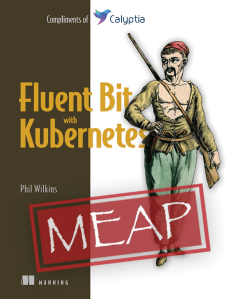
The exciting news is that Manning have released several more chapters of our Fluent Bit with Kubernetes book into the MEAP (Manning Early Access Program) – which means about two-thirds of the book is now available in MEAP form.
We’ve also been beefing up the supporting and related information on this website – as we can’t get everything into the book – for the static pages, the most relevant are here and here, and the blog post content can be seen here.
The sample configurations are in our GitHub repo here, and additional demos can be found here. We’ve got a pretty cool demo being built, which takes Fluent Bit into the world of ChatOps (and it isn’t just sending notifications) – it will eventually become visible in the repo – but to see it sooner, keep an eye out for our conference presentations.
The hyper scaler cloud vendors all offer Logging and monitoring capabilities. But they tend to focus on supporting their native services. If you’re aware of Oracle’s Cloud (OCI) messaging, then you’ll know that there is a strong recognition of the importance of multi-cloud. This extends not only to connecting apps across clouds but also to be able to observe and manage cloud-spanning solutions. Ultimately, most organizations want to headline observability-related views of their solutions.
Late last year, I presented these ideas, illustrating the ideas with the use of Fluent Bit and OCI’s Observability and Management products to visualize and analyze what is happening. I finally found the time to write how the very basic demo was built from a clean sheet over on the Oracle Devs blog on Medium.
This also highlights the fact that the Fluent Bit book, while I believe, once completed, will be through, can’t cover everything – and certainly not build end-to-end use cases like the Oracle Observability & Management example. To help address this, the book includes an appendix of helpful additional information, some of which I have included here, along with other content that we encounter – all of which can be found at Fluentd & Fluent Bit Additional stuff.
I’ve written about how railroad syntax diagrams (see here) are great for helping write code (or configuration files). Following the track through the diagram will give you the correct statement syntax, and generally, the diagrams don’t require you to jump around like BNF or eBNF representations.
As you may have seen, I’m currently writing a book on Fluent Bit, and guess what? We’re on the Stream Processor chapter. Looking broaching the use of syntax, it just felt right to have a railroad diagram. As the diagram is fairly large, it won’t print well, so here are the diagrams.
The master content is in GitHub here. If you want a quick reference to how the diagrams work, check here.
Stream Processor Configuration
Fluent Bit Stream Processor Configuration Syntax
While Fluent Bit’s core syntax is pretty straightforward, the syntax for the stream processing is a bit more complex, with a strong resemblance to SQL. As SQL is declarative in nature and can contain iterative and nested elements, RailRoad diagrams can really help.
The original BNF definition of the Stream SQL syntax is here.
Fluent Bit Configuration RailRoad Diagrams
When it comes to the core configuration files, RailRoad diagrams aren’t as effective because the configuration is more declarative in nature. But we’ve tried to capture the core essence here. The only issue is that representing things like the use of @include, which can show up in most parts of the file – arent so easy, and a list of attributes for each possible standard plugin would make the diagram enormously large and unwieldy.
Fluent Bit Classic Format Configuration
We know there are gaps in the current diagrams, which will be addressed. Including:
YAML format
@include
We should show that environment variables can be references as attributes
A better way to show the required indentation and line separation
The new book focuses on Fluent Bit, given its significant advances, reflected by the fact it is now at Version 2 and is deserving of its own title. The new book is a free-standing book but is complimentary to the Logging In Action book. Logging in Action focuses on Fluentd but compliments by addressing more deeply deployment strategies for Fluent Bit and Fluentd. The new book engages a lot more with OpenTelemetry now it has matured, along with technologies such as Prometheus.
It is the fact that we’ve seen increasing focus in the cloud native space on startup speeds and efficiency in footprints that have helped drive Fluent Bit, as it operates with native binaries rather than using a Just-In-Time compilation like Ruby (used for Fluentd). The other significant development is the support for OpenTelemetry.
The book has entered the MEAP (Manning Early Access Program). The first three chapters have been peer-reviewed, and changes have been applied; another three are with the development editor. If you’ve not read a MEAP title before, you’ll find the critical content is in the chapters, but from my experience, as we work through the process, the chapters improve as feedback is received. In addition, as an author, when we have had time away from a chapter and then revisit it – it is easier to spot things that aren’t as clear as they could be. So, it is always worth returning as a reader and looking at chapters. Then, as we move to the production phases, any linguistic or readability issues that still exist are addressed as a copy editor goes through the manuscript.
I’d like to thank those involved with the peer review. Their suggestions and insights have been really helpful. Plus, the team at Calyptia is sponsoring the book (and happens to be employing a number of the Fluent Bit contributors).
We also have a discount code on the book, valid until 20th November – mlwilkins2
Development trends have shown a shift towards precompiled languages like Go and Rust away from interpreted or Just-In-Time (JIT) compiled languages like Java and Ruby as it removes the startup time of the language virtual machine and the JIT compiler as well as a smaller memory footprint. All desirable features when you’re scaling containerized solutions and percentage point savings can really add up.
Oracle has been leading the way with its work on GraalVM for some years now, and as a result, not only can GraalVM be used to produce native binary images from Java code, GraalVM also supports TuffleRuby and GraalPy, among others. As TruffleRuby is an open-source project, Oracle isn’t the only vendor contributing to it, work effort has also come from Shopify.
Helping Ruby move forward isn’t new for the Shopify engineering team, and part of that investment is that they have just announced the open-sourcing of a toolchain called Ruvy. Ruvy takes Ruby and creates a WebAssembly (WASM) from it the code. This builds on the existing project ruby.wasm. In doing so they’ve addressed the Ruby startup overhead of the language VM we mentioned. They have also simplified the process of deployment, eliminating the need for Web Assembly System Interface (WASI) arguments, and overcome constraints of class loading by reading files by having the code bundled within the assembly and then accessing the content using WASI-VFS, a simple virtual file system.
The published benchmarks show a massive performance boost in the process of executing where the Ruby code needs to be executed by the packaged JIT. For me, this is interesting as one of the related cloud-native trends is the shift from Fluentd to Fluent Bit. Fluentd was built with Ruby and has a huge portfolio of third-party extensions. But Fluent Bit is built using C to get those performance gains previously described. But it does support plugins through WASM. This raises an interesting question can we take existing Ruby plugins and wrap them so the required interfacing works – which should be minimal and more likely to be impacted by the fact Fluent Bit v2 has refined the internal data structure that was common to both Fluentd and Fluent Bit to allow Fluent Bit to more easily engaged with OpenTelemetry.
If the extra bit of wrapping code isn’t complex, then applying Ruvy should mean the core plugin can then work with Fluent Bit. If this can be templated, then Fluent Bit is going to make a big leap forward with the number of available plugins.
We’ve just had a new article published for Software Engineering Daily which looks at monitoring in multi-cloud and hybrid use cases and highlights some strategies that can help support the single pane of glass by exploiting features in tools such as Fluentd and Fluentbit that perhaps aren’t fully appreciated. Check it out …
The 12 Factor App definition is now ten years old. In the world of software that is a long time. So perhaps it’s time to revisit and review what it says. As I have spent a lot of time around Logging – I’ve focussed on Factor 11 – Logging.
I have been fortunate enough to present at the hybrid JAX London conference on this subject. It was great to get out and see people at a conference rather than just with a screen and a chat console of online-only events.
One of the areas I present publicly is the use of Fluentd. including the use of distributed and multiple nodes. As many events have been virtual it has been easy to demo everything from my desktop – everything is set up so I can demo things very easily. While doing this all on one machine does point to how compact and efficient Fluentd is as I can run multiple instances concurrently it does undermine distributed capabilities somewhat.
Add to that I now work for Oracle it makes sense to use OCI resources. With that, I have been developing the scripts to configure Ubuntu VMs to set up the demo environments installing Ruby, Fluentd, and various gems needed and pulling the relevant configurations in. All the assets can be found in the GitHub repository https://github.com/mp3monster/logging-demos. The repository readme includes plenty of information as well.
While I’ve been putting this together using OCI, the fact that everything is based on Ubuntu should mean it can be run locally on VMs, WSL2, and adaptable for MacOS as well. The environment has been configured means you can still run on Ubuntu with a single node if desired.
Additional Log Destinations
As the demo will typically be run on OCI we can not only run the demo with a multinode setup, we have extended the setup with several inclusion files so we can utilize OCI services OpenSearch and OCI Log Analytics. If you don’t want to use these services simply replace the contents of several inclusion files including files with the contents of the dummy_inclusion.conf file provided.
Representation of the Demo setup
The configuration works by each destination having one or two inclusion files. The files with the postfix of label-inclusion.conf contains the configuration to direct traffic to the respective service with a configuration that will push log events at a very high frequency to the destination. The second inclusion file injects the duplication of log events to each service. The inclusion declarations in the main node Fluentd config file references an environment variable that should provide the path to the inclusion file to use. As a result, by changing the environment variable to point to a dummy file it becomes possible o configure out the use of one of the services. The two inclusions mean we can keep the store declarations compact and show multiple labels being used. With the OpenSearch setup, we have a variant of the inclusion file model where the route inclusion can reference the logic that we would use in the label directly within the sore declaration.
The best way to see the use of the inclusions is to experiment with setting the different environment variables to reference the different files and then using the Fluentd dry-run feature (more on this in the book).
Setup script
The setup script performs a number of tasks including:
Pulling from Git all the resources needed in terms of configuration files and folders
Retrieving the necessary plugins against the possibility of their use.
Setting up the various environment variables for:
Slack token
environment variables to reference inclusion files
shortcut environment variables and aliases
network (IP) address for external services such as OpenSearch
Setting up a folder for OCI tokens needed.
Setting up temp folders to be used by OCI Plugins as a file-based cache.
Feeding the log analytics service is a more complex process to set up as the feeds need to have metadata about the events being ingested. The downside is the configuration effort is greater, but the payback is that it becomes easier to extract meaningful information quickly because the service has a greater understanding of the content. For example, attributing the logs to a type of source means the predefined or default log formats are immediately understood, and maximum meaning can be retrieved from the log event.
Going to OCI Log Analytics does cut out the need for the Connections hub, which would allow rules and routing to be defined to different OCI services which functionally can help such as directing log events to PagerDuty.
When configuring Fluentd we often need to provide credentials to access event sources, targets, and associated services such as notification tools like Slack and PagerDuty. The challenge is that we don’t want the credentials to be in clear text in the Fluentd configuration.
Using Env Vars
In the Logging In Action with Fluentd book, we illustrated how we can take the sensitive values from environment variables so the values don’t show up in the configuration file. But, we’ve seen regularly the question of how secure is this, can’t the environment variable be seen by everyone on that machine?
The answer to this question comes down to having a deeper understanding of how environment variables work. There is a really good explanation here. The long and short of it is that environment variables can only be seen by the process that creates the variable and any child process will receive a copy of the parent’s variables.
This means that if we create the variable in a shell, only that shell and any processes launched by that shell can see the environment variable. So as long as we don’t set variables up as part of a system-level configuration then we already have a level of security. So we could wrap the start of Fluentd with a script that sets the environment variables needed. Then everything launches that script.
I’ve been fortunate enough to appear on a podcast with the excellent Coding Over Cocktails team from Toro Cloud. we got to talk about some of the ideas discussed in my Logging In Action book. You can check the podcast out via their website which includes all the episode details and links to all the platforms that host the podcast. There have been some great previous guests such as Luis Weir (my old boss), Chris Richardson of Microservices.io, Matthew Reinbold from Postman, Sam Newman to name just a few.



You must be logged in to post a comment.