• Home
  • Site Aliases
    • www.cloud-native.info
  • About
    • Background
    • Presenting Activities
    • Internet Profile
      • LinkedIn
    • About
  • Books & Publications
    • Log Generator
    • Logs and Telemetry using Fluent Bit
      • Fluent Bit book
      • Book Resources in GitHub
      • Fluent Bit Classic to YAML Format configurations
    • Logging in Action with Fluentd, Kubernetes and More
      • Logging in Action with Fluentd – Book
      • Fluentd Book Resources
      • Fluentd & Fluent Bit Additional stuff
    • API & API Platform
      • API Useful Resources
    • Oracle Integration
      • Book Website
      • Useful Reading Sources
    • Publication Contributions
  • Resources
    • GitHub
    • Oracle Integration Site
    • Oracle Resources
    • Mindmaps Index
    • Useful Tech Resources
      • Fluentd & Fluent Bit Additional stuff
      • Recommended Tech Podcasts
      • Official Sources for Product Logos
      • Java and Graal Useful Links
      • Python Setup & related stuff
  • Music
    • Monster On Music
    • Music Listening
    • Music Reading

Phil (aka MP3Monster)'s Blog

~ from Technology to Music

Phil (aka MP3Monster)'s Blog

Category Archives: development

Observations on vibe coding Fluent Bit configurations

13 Thursday Nov 2025

Posted by mp3monster in AI, development, Fluentbit, General, Technology

≈ Leave a comment

Tags

AI, Cline, code generation, configuration, Fluent Bit, Grok, LLM, LLMs, observations, plugins, prompt engineering, prompts, vibe coding

With vibe coding (an expression now part of the Collins Dictionary) and tools like Cline, which are penetrating the development process, I thought it would be worthwhile to see how much can be done with an LLM for building configurations. Since our preference for a free LLM has been with Grok (xAI) for development tasks, we’ve used that. We found that beyond the simplest of tasks, we needed to use the Expert level to get reliable results.

This hasn’t been a scientific study, as you might find in natural language-to-SQL research, such as the Bird, Archer, and Spider benchmarks. But I have explained below what I’ve tried and the results. Given that LLMs are non-deterministic, we tried the same question from different browser sessions to see how consistent the results were.

Ask the LLM to list all the plugins it knows about

To start simply, it is worth seeing how many plugins the LLM might recognize. To evaluate this, we asked the LLM to answer the question:

list ALL fluent bit input plugins and a total count

Grok did a pretty good job of saying it counted around 40. But the results did show some variation: on one occasion, it identified some plugins as special cases, noting the influence of compilation flags; on another attempt, no references were made to this. In the first attempts, it missed the less commonly discussed plugins such as eBPF. Grok has the option to ask it to ‘Think Harder’ (which switches to Exper mode) when we applied this, it managed to get the correct count, but in another session, it also dramatically missed the mark, reporting only 28 plugins.

Ask the LLM about all the attributes for a Plugin

To see if the LLM could identify all the attributes of a plugin, we used the prompt:

list all the known configuration attributes for the Fluent Bit Tail plugin

Again, here we saw some variability, with the different sessions providing between 30 and 38 attributes (again better results when in Expert mode). In all cases, the main attributes have been identified, but what is interesting is that there were variations in how they have been presented, some in all lowercase, others with leading capitalization.

Ask the LLM to create a regular expression

Regular expressions are a key way of teasing out values that may appear in semi-structured or unstructured logs. To determine if the LLM could do this, we used the following prompt:

Create a regular expression that Fluent Bit could execute that will determine if the word fox appears in a single sentence, such as 'the quick brown fox jumped over the fence'

The result provided offered variations on the expression \bfox\b (sometimes allowing for the possibility that Fox might be capitalized). In each of the cases where we went back to the LLM and added to the prompt that Note that the expression should be case sensitive – It was consistently correct.

The obvious takeaway here is that to avoid any errors, we do need to be very explicit.

Ask the LLM to create a simple filter and output

Given that we can see the LLM understands the most commonly used Fluent Bit plugins, let’s provide a simple scenario with a source log that will have some rotation, and see how it processes it. The prompt provided is:

create a classic configuration for fluent bit that will read an input from a file called myApp which has a post fix with the date. The input needs to take into account that the file extension will change at midnight. Any log entries that show an error and reference an IP need to be filtered to go to a CSV file with columns in the order tag, IP, log, timestamp

The handling of this question differed significantly across sessions: one response implemented filtering and output structuring via a Lua function, while another maximized the use of multiple filters. None of the solutions recognized that the output could reference standard Fluent Bit attributes for the tag and timestamp.

What was interesting was that the LLM also picked up on the possibility of externalizing the parser expressions, such as finding the IP. Interestingly, Fluent Bit includes a predefined set of filters, including an IPv4 filter.

Ask the LLM to use a stream processor

Stream Processors are a less commonly used feature of Fluent Bit, so it would be interesting to see how well the LLM can handle such use cases.

create a Fluent Bit YAML configuration which takes an NGINX log file input and uses a SQL stream processor to count the number of calls identified and the average time between these calls as coming from IP addresses starting 10. every minute. The NGINX logs need to be forwarded to a fluent bit node on the server named ops.myCorp.com and the output of the stream processing needs to go to a local log file called counter.txt and written to a Prometheus end point called ops_prometheus.myCorp.com

The result of this prompt comes in two parts. A main configuration:

service:
  log_level: info
  flush: 1

pipeline:
  inputs:
    - name: forward
      host: 0.0.0.0
      port: 24224
      tag: nginx

  filters:
    - name: parser
      match: nginx
      key_name: log
      parser: nginx
      reserve_data: true

  outputs:
    - name: file
      match: ip10.stats
      path: /var/log/counter.txt  # Adjust path as needed
      format: template
      template: '{ "timestamp": "{time}", "count": {count}, "avg_interval": {avg_interval} }'

    - name: prometheus_remote_write
      match: ip10.stats
      host: ops_prometheus.myCorp.com
      port: 9091  # Common port for Prometheus remote write; adjust if needed
      add_label:
        - job fluent-bit
        - instance ${HOSTNAME}

parsers:
  - name: nginx
    format: regex
    regex: '^(?<remote>[^ ]*) (?<host>[^ ]*) (?<user>[^ ]*) \[(?<time>[^\]]*)\] "(?<method>\S+)(?: +(?<path>[^\"]*?)(?: +\S*)?)?" (?<code>[^ ]*) (?<size>[^ ]*)(?: "(?<referer>[^\"]*)" "(?<agent>[^\"]*)"(?: "(?<xforwardfor>[^\"]*)")?)?$'
    time_key: time
    time_format: '%d/%b/%Y:%H:%M:%S %z'

stream_processor:
  - name: ip10_stats
    exec: "CREATE STREAM ip10_stats WITH (tag='ip10.stats') AS SELECT COUNT(*) AS count, (MAX(RECORD_TIME()) - MIN(RECORD_TIME())) / (COUNT(*) - 1) AS avg_interval FROM TAG:'nginx' WHERE remote LIKE '10.%' WINDOW TUMBLING (1 MINUTE);"

The configuration for the second node provided is:

service:
  log_level: info

pipeline:
  inputs:
    - name: tail
      path: /path/to/nginx/access.log  # Adjust to your NGINX access log path
      tag: nginx
      db: /var/log/fluent-bit-tail.db  # For position tracking

  outputs:
    - name: forward
      match: nginx
      host: ops.myCorp.com
      port: 24224

As you can see, while the configuration is well-formed, the LLM has confused the input and output requirements. This is because we have not been explicit enough about the input. The thing to note is that if we tweak the prompt to be more explicit and resubmit it, we get the same mistake, but submitting the same revised prompt produces the correct source. We can only assume that this is down to the conversational memory yielding a result that takes precedence over anything older. For transparency, here is the revised prompt with the change underlined.

create a Fluent Bit YAML configuration which takes an NGINX log file as an input. The NGINX input uses a SQL stream processor to count the number of calls identified and the average time between these calls as coming from IP addresses starting 10. every minute. The input NGINX logs need to be output by forwarding them to a fluent bit node on the server named ops.myCorp.com and the output of the stream processing needs to go to a local log file called counter.txt and written to a Prometheus end point called ops_prometheus.myCorp.com 

The other point of note in the generated configuration provided is that there doesn’t appear to be a step that matches the nginx tag, but results in events with the tag ip10.stats. This is a far more subtle problem to spot.

What proved interesting is that, with a simpler calculation for the stream, the LLM in an initial session ignored the directive to use the stream processor and instead used the logs_to_metrics filter, which is a simpler, more maintainable approach.

Creating Visualizations of Configurations

One of the nice things about using an LLM is that, given a configuration, it can create a visual representation (directly) or in formats such as Graphviz, Mermaid, or D2. This makes it easier to follow diagrams immediately. Here is an example based on a corrected Fluent Bit configuration:

The above diagram was created by the LLM as a mermaid file as follows
graph TD
A[NGINX Log File
/var/log/nginx/access.log] -->|"Tail Input & Parse (NGINX regex)"| B[Fluent Bit Pipeline
Tag: nginx.logs]
B -->|Forward Output| C[Remote Fluent Bit Node
ops.myCorp.com:24224]
B -->|"SQL Stream Processor
Filter IPs starting '10.'
Aggregate every 60s: count & avg_time"| D[Aggregated Results
Tag: agg.results]
D -->|"File Output
Append template lines"| E[Local File
/var/log/counter.txt]
D -->|"Prometheus Remote Write Output
With custom label"| F[Prometheus Endpoint
ops_prometheus.myCorp.com:443]

Lua and other advanced operations

When it comes to other advanced features, the LLM appears to handle this well, but given that there is plenty of content available on the use of Lua, the LLM could have been trained on. The only possible source of error would be the passing of attributes in and out of the Lua script, which it handled correctly.

We experimented with handling open telemetry traces, which were handled without any apparent issues. Although advanced options like compression control weren’t included (and neither were they requested).

We didn’t see any hallucinations when it came to plugin attributes. When we tried to ‘bait’ the LLM into hallucinating an attribute by asking it to use an attribute that doesn’t exist, it responded by adding the attribute along with a configuration comment that the value was not a valid Fluent Bit attribute.

General observations

One thing that struck me about this is that describing what is wanted with sufficient detail for the LLM requires a higher level of focus (albeit for a shorter period) than manually creating the configuration. The upside is that we are, in effect, generating part of a detailed design document. Today, I’d go so far as to suggest including the prompt(s) used in the configuration header(s) to help people understand what is needed from the configuration.

When the LLM generates the configuration, there will be no escaping the need to understand what the plugins do and the options they offer to determine whether the LLM has got it right. If the LLM gets it wrong, we would recommend starting a fresh session.

This does raise a bit of an interesting challenge. If you need to have a fair handle on how Fluent Bit works and common ways plugins work, then actually writing your own configuration files may be better anyway, as that approach will provide more reinforcement to learning. We, of course, can use the LLM to help ‘peer review’ our configurations in the sense of checking syntax, and generating visual representations can help confirm the configuration is as we expect.

This may be a personal thing, as I find myself working with Fluent Bit in small bursts rather than continually. As a result, I remember what I can do with a plugin, but I often forget the exact names of the less commonly used attributes to effect the desired behavior. Looking up, and keying in the attribute names can take time. One thing that we have tried was to include in the prompt statements, such as:

In the configuration include all the attributes even if they are only populated with their default or example values. Add a comment for each attribute to show its surpose and whether it is mandatory or not.

What you get then is all the possible options, with the correct names (something that is easy for the LLM, as it is essentially asking it to reformat the documentation for you). Then it becomes a case of removing the attributes that aren’t needed line by line—a lot quicker and easier than manually adding them.

LLM generated plugin with all attributes described (slightly modified output to make the point clearer).
[INPUT]
   Name tail  
     # Purpose: Specifies the input plugin to use. Mandatory: yes
   buffer_chunk_size 32k   
     # Purpose: Set the initial buffer size to read file data. The value must be according to the Unit Size specification. Mandatory: no
   buffer_max_size 32k  
    # Purpose: Set the limit of the buffer size per monitored file. If reading a file exceeds this limit, the file is removed from the monitored file list. The value must be according to the Unit Size specification. Mandatory: no
   path /var/log/blah.txt  
    # Purpose: Pattern specifying a specific log file or multiple ones through the use of common wildcards. Allows multiple patterns separated by commas. Mandatory: yes
    path_key filename  
     # Purpose: If enabled, it appends the name of the monitored file as part of the record. The value assigned becomes the key in the map. Mandatory: no
  exclude_path *.gz,*.zip  
     # Purpose: Set one or multiple shell patterns separated by commas to exclude files matching certain criteria, e.g., *.gz,*.zip. Mandatory: no
  offset_key offset  
     # Purpose: If enabled, Fluent Bit appends the offset of the current monitored file as part of the record. The value assigned becomes the key in the map. Mandatory: no
  read_from_head false  
    # Purpose: For new discovered files on start (without a database offset/position), read the content from the head of the file, not tail. Mandatory: no
  refresh_interval 60  
    # Purpose: The interval of refreshing the list of watched files in seconds. Mandatory: no
  rotate_wait 5  
    # Purpose: Specify the number of extra time in seconds to monitor a file once it is rotated in case some pending data is flushed. Mandatory: no
  ignore_older 1d  
    # Purpose: Ignores files older than ignore_older. Supports m, h, d (minutes, hours, days) syntax. Mandatory: no
  ignore_active_older_files  false  
    # Purpose: Ignore files that are older than the value set in ignore_older even if the file is being ingested. Mandatory: no
  skip_long_lines off  
    # Purpose: When a monitored file reaches its buffer capacity due to a very long line (buffer_max_size), the default behavior is to stop monitoring that file. skip_long_lines alters that behavior and instructs Fluent Bit to skip long lines and continue processing other lines that fit into the buffer size. Mandatory: no
  skip_empty_lines off  
    # Purpose: Skips empty lines in the log file from any further processing or output. Mandatory: no
  db /fluent-bit/tail/blah.db  
    # Purpose: Specify the database file to keep track of monitored files and offsets. Recommended to be unique per plugin. Mandatory: no
  db.sync normal  
    # Purpose: Set a default synchronization (I/O) method. Affects how the internal SQLite engine synchronizes to disk. Values: extra, full, normal, off. Mandatory: no
  db.locking false  
    # Purpose: Specify that the database will be accessed only by Fluent Bit. Enabling this increases performance but restricts external tools from querying the content. Mandatory: no
  db.journal_mode wal  
    # Purpose: Sets the journal mode for databases (wal). Enabling wal provides higher performance. Not compatible with shared network file systems. Mandatory: no
  db.compare_filename false  
    # Purpose: Determines whether to review both inode and filename when retrieving stored file information from the database. true verifies both; false checks only the inode. Mandatory: no
  mem_buf_limit 10MB  
    # Purpose: Set a memory limit that the Tail plugin can use when appending data to the engine. If the limit is reached, it will be paused. When the data is flushed, it resumes. Mandatory: no
  exit_on_eof false  
    # Purpose: When reading a file, exit as soon as it reaches the end of the file. Used for bulk load and tests. Mandatory: no
  parser none  
    # Purpose: Specify the name of a parser to interpret the entry as a structured message. Mandatory: no
  key log  
   # Purpose: When a message is unstructured (no parser applied), it's appended as a string under the key name log. This option lets you define an alternative name for that key. Mandatory: no
  inotify_watcher true  
   # Purpose: Set to false to use file stat watcher instead of inotify. Mandatory: no
  tag blah.logs  
   # Purpose: Set a tag with regexextract fields that will be placed on lines read. Supports tag expansion: if the tag includes an asterisk (*), that asterisk will be replaced with the absolute path of the monitored file, with slashes replaced by dots. Mandatory: no
  tag_regex (?<pod_name>[a-z0-9](?:[-a-z0-9]*[a-z0-9])?(?:\\.[a-z0-9]([-a-z0-9]*[a-z0-9])?)*)_(?<namespace_name>[^_]+)_(?<container_name>.+)-(?<container_id>[a-z0-9]{64})\.log$  
    # Purpose: Set a regular expression to extract fields from the filename. Mandatory: no
  static_batch_size 50M  
    # Purpose: Set the maximum number of bytes to process per iteration for the monitored static files (files that already exist upon Fluent Bit start). Mandatory: no
  file_cache_advise on  
    # Purpose: Set the posix_fadvise in POSIX_FADV_DONTNEED mode. This reduces the usage of the kernel file cache. This option is ignored if not running on Linux. Mandatory: no
  threaded false  
    # Purpose: Indicates whether to run this input in its own thread. Mandatory: no
  Unicode.Encoding none  
    # Purpose: Set the Unicode character encoding of the file data. Requests two-byte aligned chunk and buffer sizes. Supported values: UTF-16LE, UTF-16BE, and auto. Mandatory: no
  Generic.Encoding none  
    # Purpose: Set the non-Unicode encoding of the file data. Supported values: ShiftJIS, UHC, GBK, GB18030, Big5, Win866, Win874, Win1250, Win1251, Win1252, Win1254, Win1255, Win1256. Mandatory: no
  multiline.parser docker,cri  
    # Purpose: Specify one or multiple Multiline Parser definitions to apply to the content. When using a new multiline.parser definition, you must disable the old configuration from your tail section (e.g., parser, parser_firstline, parser_N, multiline, multiline_flush, docker_mode). Mandatory: no
  multiline off  
    # Purpose: If enabled, the plugin will try to discover multiline messages and use the proper parsers to compose the outgoing messages. When this option is enabled, the parser option isn't used. Mandatory: no
  multiline_flush 4  
    # Purpose: Wait period time in seconds to process queued multiline messages. Mandatory: no
  parser_firstline none  
    # Purpose: Name of the parser that matches the beginning of a multiline message. The regular expression defined in the parser must include a group name (named capture), and the value of the last match group must be a string. Mandatory: no
  parser_1 example_parser  
    # Purpose: Optional. Extra parser to interpret and structure multiline entries. This option can be used to define multiple parsers. For example, parser_1 ab1, parser_2 ab2, parser_N abN. Mandatory: no
  docker_mode off  
    # Purpose: If enabled, the plugin will recombine split Docker log lines before passing them to any parser. This mode can't be used at the same time as Multiline. Mandatory: no
  docker_mode_flush 4  
   # Purpose: Wait period time in seconds to flush queued unfinished split lines. Mandatory: no
  docker_mode_parser none  
    # Purpose: Specify an optional parser for the first line of the Docker multiline mode. The parser name must be registered in the parsers.conf file. Mandatory: no

[OUTPUT]
  Name   stdout
  Match  *
  Format json_lines

[OUTPUT] Name stdout Match * Format json_lines

I would also suggest it is worth trying the same prompt is separate conversations/sessions to see how much variability in approach to using Fluent Bit is thrown up. If the different sessions yield very similar solutions, then great. If the approaches adopted are different, then it is worth evaluating the options, but also considering what in your prompt might need clarifying (and therefore the problem being addressed).

Generating a diagram to show the configuration is also a handy way to validate whether the flow of events through it will be as expected.

The critical thing to remember is that the LLM won’t guarantee that what it provides is good practice. The LLM is generating a configuration based on what it has seen, which can be both good and bad. Not to mention applying good practice demands that we understand why a particular practice is good, and when it is to our benefit. It is so easy to forget that LLMs are primarily exceptional probability engines with feedback loops, and their reasoning is largely probabilities, feedback loops, and some deterministic tooling.

Share this:

  • Click to share on Facebook (Opens in new window) Facebook
  • Click to share on X (Opens in new window) X
  • Click to share on Pocket (Opens in new window) Pocket
  • Click to share on Reddit (Opens in new window) Reddit
  • Click to email a link to a friend (Opens in new window) Email
  • Click to share on WhatsApp (Opens in new window) WhatsApp
  • Click to print (Opens in new window) Print
  • Click to share on Tumblr (Opens in new window) Tumblr
  • Click to share on Mastodon (Opens in new window) Mastodon
  • Click to share on Pinterest (Opens in new window) Pinterest
  • More
  • Click to share on Bluesky (Opens in new window) Bluesky
  • Click to share on LinkedIn (Opens in new window) LinkedIn
Like Loading...

MCP Security

30 Thursday Oct 2025

Posted by mp3monster in AI, development, General, Technology

≈ Leave a comment

Tags

AI, artificial-intelligence, attack, attacks, cybersecurity, MCP, model context protocol, Paper, Security, Technology, vectors

MCP (Model Context Protocol) has really taken off as a way to amplify the power of AI, providing tools for utilising data to supplement what a foundation model has already been trained on, and so on.

With the rapid uptake of a standard and technology that has been development/implementation led aspects of governance and security can take time to catch up. While the use of credentials with tools and how they propagate is well covered, there are other attack vectors to consider. On the surface, it may seem superficial until you start looking more closely. A recent paper Model Context Protocol (MCP): Landscape, Security Threats, and Future Research Directions highlights this well, and I thought (even if for my own benefit) to explain some of the vectors.

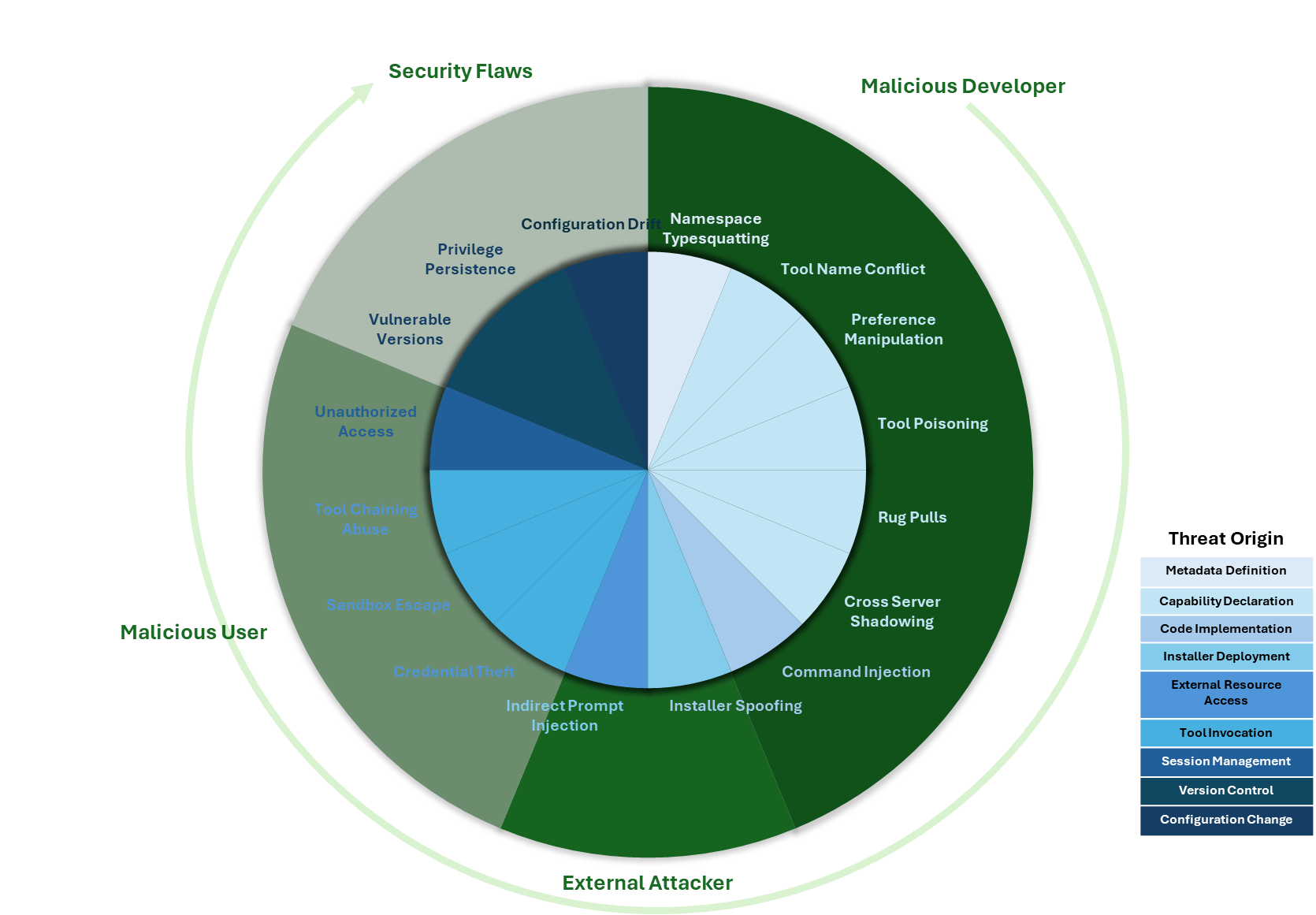
I’ve also created a visual representation based on the paper of the vectors described.

The inner ring represents each threat, with its color denoting the likely origin of the threat. The outer ring groups threats into four categories, reflecting where in the lifecycle of an MCP solution the threat could originate.

I won’t go through all the vectors in detail, though I’ve summarized them below (the paper provides much more detail on each vector). But let’s take a look at one or two to highlight the unusual nature of some of the issues, where the threat in some respects is a hybrid of potential attack vectors we’ve seen elsewhere. It will be easy to view some of the vectors as fairly superficial until you start walking through the consequences of the attack, at which point things look a lot more insidious.

Several of the vectors can be characterised as forms of spoofing, such as namespace typosquatting, where a malicious tool is registered on a portal of MCP services, appearing to be a genuine service — for example, banking.com and bankin.com. Part of the problem here is that there are a number of MCP registries/markets, but the governance they have and use to mitigate abuse varies, and as this report points out, those with stronger governance tend to have smaller numbers of services registered. This isn’t a new problem; we have seen it before with other types of repositories (PyPI, npm, etc.). The difference here is that the attacker could install malicious logic, but also implement identity theft, where a spoofed service mimics the real service’s need for credentials. As the UI is likely to be primarily textual, it is far easier to deceive (compared to, say, a website, where the layout is adrift or we inspect URIs for graphics that might give clues to something being wrong). A similar vector is Tool Name Conflict, where the tool metadata provided makes it difficult for the LLM to distinguish the correct tool from a spoofed one, leading the LLM to trust the spoof rather than the user.

Another vector, which looks a little like search engine gaming (additional text is hidden in web pages to help websites improve their search rankings), is Preference Manipulation Attacks, where the tool description can include additional details to prompt the LLM to select one solution over another.

The last aspect of MCP attacks I wanted to touch upon is that, as an MCP tool can provide prompts or LLM workflows, it is possible for the tool to co-opt other utilities or tools to action the malicious operations. For example, an MCP-provided prompt or tool could ask the LLM to use an approved FTP tool to transfer a file, such as a secure token, to a legitimate service, such as Microsoft OneDrive, but rather than an approved account, it is using a different one for that task. While the MCP spec says that such external connectivity actions should have the tool request approval, if we see a request coming from something we trust, it is very typical for people to just say okay without looking too closely.

Even with these few illustrations, tooling interaction with an LLM comes with deceptive risks, partially because we are asking the LLM to work on our behalf, but we have not yet trained LLMs to reason about whether an action’s intent is in the user’s best interests. Furthermore, we need to educate users on the risks and telltale signs of malicious use.

Attack Vector Summary

The following list provides a brief summary of the attack vectors. The original paper examines each in greater depth, illustrating many of the vectors and describing possible mitigation strategies. While many technical things can be done. One of the most valuable things is to help potential users understand the risks, use that to guide which MCP solutions are used, and watch for signs that things aren’t as they should be.

Continue reading →

Share this:

  • Click to share on Facebook (Opens in new window) Facebook
  • Click to share on X (Opens in new window) X
  • Click to share on Pocket (Opens in new window) Pocket
  • Click to share on Reddit (Opens in new window) Reddit
  • Click to email a link to a friend (Opens in new window) Email
  • Click to share on WhatsApp (Opens in new window) WhatsApp
  • Click to print (Opens in new window) Print
  • Click to share on Tumblr (Opens in new window) Tumblr
  • Click to share on Mastodon (Opens in new window) Mastodon
  • Click to share on Pinterest (Opens in new window) Pinterest
  • More
  • Click to share on Bluesky (Opens in new window) Bluesky
  • Click to share on LinkedIn (Opens in new window) LinkedIn
Like Loading...

Logging Best Practices – a sort of new book

21 Thursday Aug 2025

Posted by mp3monster in Books, development, Fluentbit, Fluentd, General, Technology

≈ 1 Comment

Tags

book, books, ebook, reading, writing

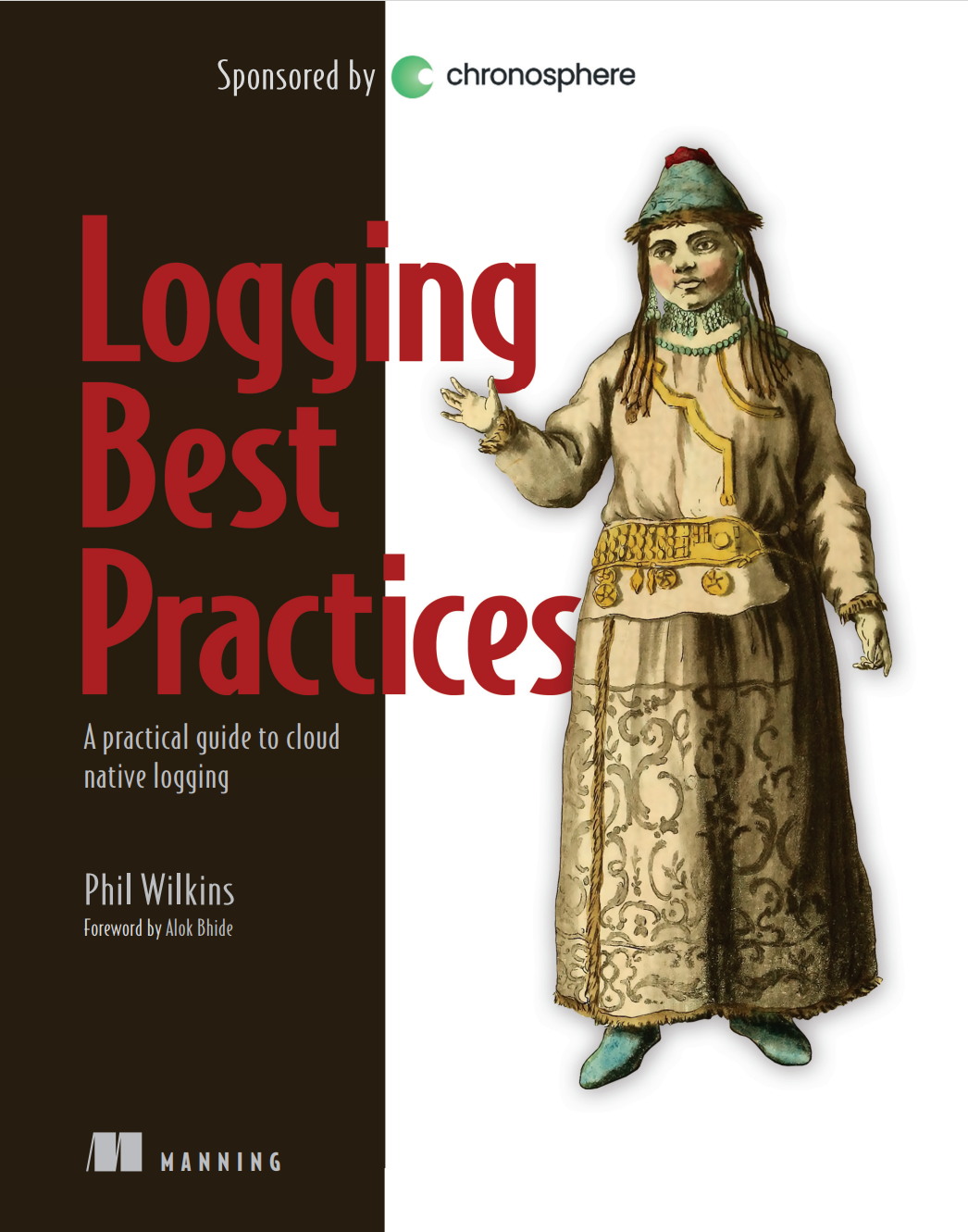
So, there is a new book title published with me as the author (Logging Best Practices) published by Manning, and yes, the core content has been written by me. But was I involved with the book? Sadly, not. So what has happened?

Background

To introduce the book, I need to share some background. A tech author’s relationship with their publisher can be a little odd and potentially challenging (the editors are looking at the commerciality – what will ensure people will consider your book, as well as readability; as an author, you’re looking at what you think is important from a technical practitioner).

It is becoming increasingly common for software vendors to sponsor books. Book sponsorship involves the sponsor’s name on the cover and the option to give away ebook copies of the book for a period of time, typically during the development phase, and for 6-12 months afterwards.

This, of course, comes with a price tag for the sponsor and guarantees the publisher an immediate return. Of course, there is a gamble for the publisher as you’re risking possible sales revenue against an upfront guaranteed fee. However, for a title that isn’t guaranteed to be a best seller, as it focuses on a more specialized area, a sponsor is effectively taking the majority investment risk from the publisher (yes, the publisher still has some risk, but it is a lot smaller).

When I started on the Fluent Bit book (Logs and Telemetry), I introduced friends at Calyptia to Manning, and they struck a deal. Subsequently, Calyptia was acquired by Chronosphere (Chronosphere acquires Calyptia), so they inherited the sponsorship. An agreement I had no issue with, as I’ve written before, I write as it is a means to share what I know with the broader community. It meant my advance would be immediately settled (the advance, which comes pretty late in the process, is a payment that the publisher recovers by keeping the author’s share of a book sale).

The new book…

How does this relate to the new book? Well, the sponsorship of Logs and Telemetry is coming to an end. As a result, it appears that the commercial marketing relationship between Chronosphere and Manning has reached an agreement. Unfortunately, in this case, the agreement over publishing content wasn’t shared with the author or me, or the commissioning editor at Manning I have worked with. So we had no input on the content, who would contribute a foreword (usually someone the author knows).

Manning is allowed to do this; it is the most extreme application of the agreement with me as an author. But that isn’t the issue. The disappointing aspect is the lack of communication – discovering a new title while looking at the Chronosphere website (and then on Manning’s own website) and having to contact the commissioning editor to clarify the situation isn’t ideal.

Reading between the lines (and possibly coming to 2 + 2 = 5), Chronosphere’s new log management product launch, and presumably being interested in sponsoring content that ties in. My first book with Manning (Logging in Action), which focused on Fluentd, includes chapters on logging best practices and using logging frameworks. As a result, a decision was made to combine chapters from both books to create the new title.

Had we been in the loop during the discussion, we could have looked at tweaking the content to make it more cohesive and perhaps incorporated some new content – a missed opportunity.

If you already have the Logging in Action and Logs and Telemetry titles, then you already have all the material in Logging Best Practices. While the book is on the Manning site, if you follow the link or search for it, you’ll see it isn’t available. Today, the only way to get a copy is to go to Chronosphere and give them your details. Of course, suppose you only have one of the books. In that case, I’d recommend considering buying the other one (yes, I’ll get a small single-digit percentage of the money you spend), but more importantly, you’ll have details relating to the entire Fluent ecosystem, and plenty of insights that will help even if you’re currently only focused on one of the Fluent tools.

Going forward

While I’m disappointed by how this played out, it doesn’t mean I won’t work with Manning again. But we’ll probably approach things a little differently. At the end of the day, the relationship with Manning extends beyond commercial marketing.

  • Manning has a tremendous group of authors, and aside from writing, the relationship allows me to see new titles in development.
  • Working with the development team is an enriching experience.
  • It is a brand with a recognized quality.
  • The social/online marketing team(s) are great to interact with – not just to help with my book, but with opportunities to help other authors.

As to another book, if there was an ask or need for an update on the original books, we’d certainly consider it. If we identify an area that warrants a book and I possess the necessary knowledge to write it, then maybe. However, I tend to focus on more specialized domains, so the books won’t be best-selling titles. It is this sort of content that is most at risk of being disrupted by AI, and things like vibe coding will have the most significant impact, making it the riskiest area for publishers. Oh, and this has to be worked around the day job and family.

Share this:

  • Click to share on Facebook (Opens in new window) Facebook
  • Click to share on X (Opens in new window) X
  • Click to share on Pocket (Opens in new window) Pocket
  • Click to share on Reddit (Opens in new window) Reddit
  • Click to email a link to a friend (Opens in new window) Email
  • Click to share on WhatsApp (Opens in new window) WhatsApp
  • Click to print (Opens in new window) Print
  • Click to share on Tumblr (Opens in new window) Tumblr
  • Click to share on Mastodon (Opens in new window) Mastodon
  • Click to share on Pinterest (Opens in new window) Pinterest
  • More
  • Click to share on Bluesky (Opens in new window) Bluesky
  • Click to share on LinkedIn (Opens in new window) LinkedIn
Like Loading...

Fluent Bit 4.0.4

21 Monday Jul 2025

Posted by mp3monster in development, Fluentbit, General, Technology

≈ 1 Comment

Tags

characters, encoding, filters, Fluent Bit, fstat, GBK, Lua, Open Telemetry, ShiftJIS, tail, Technology, WhatWG

The latest release of Fluent Bit is only considered a patch release (based on SemVer naming). But given the enhancements included it would be reasonable to have called it a minor change. There are some really good enhancements here.

Character Encoding

As all mainstream programming languages have syntaxes that lend themselves to English or Western-based languages, it is easy to forget that a lot of the global population use languages that don’t have this heritage, and therefore can’t be encoded using UTF-8. For example, according to the World Factbook, 13.8% speak Mandarin Chinese. While this doesn’t immediately translate into written communication or language use with computers, it is a clear indicator that when logging, we need to support log files that can be encoded to support idiomatic languages, such as Simplified Chinese, and recognized extensions, such as GSK and BIG5. However, internally, Fluent Bit transmits the payload as JSON, so the encoding needs to be handled. This means log file ingestion with the Tail plugin ideally needs to support such encodings. To achieve this, the plugin features a native character encoding engine that can be directed using a new attribute called generic. encoding, which is used to specify the encoding the file is using.

service:
  flush: 1

pipeline:
  inputs:
    - name: tail
      path: ./basic-file.gsk
      read_from_head: true
      exit_on_eof: true
      tag: basic-file
      generic.encoding: gsk

  outputs:
    - name: stdout
      match: "*"

The encoders supported out of the box, and the recognized names (in italics are) are:

  • GB18030 (earlier Simplifed Chinese Standard from the Chinese government called Information Technology – Chinese coded character set)
  • GBK (standard that extends the GB18030 standard for Simplified Chinese)
  • UHC (Unified Hangul Code also known as Extended Wandung – for Korean)
  • ShiftJIS (Japanese characters)
  • Big5 (for Chinese as used in Taiwan, Hong Kong, Macau)
  • Win866 (Cyrillic Russian)
  • Win874 (Thai)
  • Win1250 (Latin 2 & Central European languages)
  • Win1251 (Cyrillic)
  • Win1252 (Latin 1 & Western Europe)
  • Win1254 (Turkish)
  • Win1255 (also known as cp1255 and supports Hebrew)
  • Win1256 (Arabic)
  • Win2513 (suspect this should be Win1253, which covers the Greek language)

These standards are governed by the WhatWG specification (Web Hypertext Application Technology Group), not a well-known name, but have an agreement with the well-known W3C for various HTML and related standards.

The Win**** encodings are Windows-based formats that predate the adoption of UTF-8 by Microsoft.

Log Rotation handling

The Tail plugin, has also seen another improvement. Working with remote file mounts has been challenging, as it is necessary to ensure that file rotation is properly recognized. To improve the file rotation recognition, Fluent Bit has been modified to take full advantage of fstat. From a configuration perspective, we’ll not see any changes, but from the viewpoint of handling edge cases the plugin is far more robust.

Lua scripting for OpenTelemetry

In my opinion, the Lua plugin has been an underappreciated filter. It provides the means to create customized filtering and transformers with minimal overhead and effort. Until now, Lua has been limited in its ability to interact with OpenTelemetry payloads. This has been rectified by introducing a new callback signature with an additional parameter, which allows access to the OLTP attributes, enabling examination and, if necessary, return of a modified set. The new signature does not invalidate existing Lua scripts with the older three or four parameters. So backward compatibility is retained.

The most challenging aspect of using Lua scripts with OpenTelemetry is understanding the attribute values. Given this, let’s just see an example of the updated Lua callback. We’ll explore this feature further in future blogs.

function cb(tag, ts, group, metadata, record)
  if group['resource']['attributes']['service.name'] then
    record['service_name'] = group['resource']['attributes']['service.name']
  end

  if metadata['otlp']['severity_number'] == 9 then
    metadata['otlp']['severity_number'] = 13
    metadata['otlp']['severity_text'] = 'WARN'
  end

  return 1, ts, metadata, record
end

Other enhancements

With nearly every release of Fluent Bit, you can find plugin enhancements to improve performance (e.g., OpenTelemetry) or leverage the latest platform enhancements, such as AWS services.

Links

  • Fluent Bit
  • Fluent Bit on GitHub
  • Logs and Telemetry (Using Fluent Bit)

Share this:

  • Click to share on Facebook (Opens in new window) Facebook
  • Click to share on X (Opens in new window) X
  • Click to share on Pocket (Opens in new window) Pocket
  • Click to share on Reddit (Opens in new window) Reddit
  • Click to email a link to a friend (Opens in new window) Email
  • Click to share on WhatsApp (Opens in new window) WhatsApp
  • Click to print (Opens in new window) Print
  • Click to share on Tumblr (Opens in new window) Tumblr
  • Click to share on Mastodon (Opens in new window) Mastodon
  • Click to share on Pinterest (Opens in new window) Pinterest
  • More
  • Click to share on Bluesky (Opens in new window) Bluesky
  • Click to share on LinkedIn (Opens in new window) LinkedIn
Like Loading...

Think Distributed Systems

26 Monday Aug 2024

Posted by mp3monster in Book Reviews, development, General, manning, Technology

≈ Leave a comment

Tags

book, distributed, locking, locks, parrallelism, threading

One of the benefits of being an author with a publisher like Manning is being given early access to books in development and being invited to share my thoughts. Recently, I was asked if I’d have a look at Think Distributed Systems by Dominik Tornow.

Systems have become increasingly distributed for years, but the growth has been accelerating fast, enabled by technologies like CORBA, SOAP, REST frameworks, and microservices. However, some distribution challenges even manifest themselves when using multithreading applications. So, I was very interested in seeing what new perspectives could be offered that may help people, and Dominik has given us a valuable perspective.

I’ve been fortunate enough that my career started with working on large multi-server, multithreaded mission-critical systems. Using Ada and working with a mentor who challenged me to work through such issues. How does this relate to the book? This work and the mentor meant I built some good mental models of distributed development early in my career. Dominik calls out that having good mental models to understand distributed systems and the challenges they can bring is key to success. It’s this understanding that equips you to understand challenges such as resource locking, contending with mutual deadlock, transaction ordering, the pros and cons of optimistic locking, and so on.

As highlighted early on in this book, most technical books come from the perspective of explaining tools, languages, or patterns and to make the examples easy to follow, the examples tend to be fairly simplistic. This is completely understandable; these books aim to teach the features of the language. Not how to bring these things to bear in complex real-world use cases. As a result, we don’t necessarily get the fullest insight and understanding of the problems that can come with optimistic locking.

Given the constraints of explaining through the use of programming features, the book takes a language-agnostic approach to explaining the ideas, and complexities of distributed solutions. Instead, the book favors using examples, analogies, and mathematics to illustrate its points. The mathematics is great at showing the implications of different aspects of distributed systems. But, for readers like me who are more visual and less comfortable with numeric abstraction, this does mean some parts of the book require more effort – but it is worth it. You can’t deny hard numeric proofs can really land a message, and if you know what the variables are that can change a result, you’re well on your way.

For anyone starting to design and implement distributed and multi-threaded applications for the first time, I’d recommend looking at this book. From what I’ve seen so far, the lessons you’ll take away will help keep you from walking into some situations that can be very difficult to overcome later or, worse, only manifest themselves when your system starts to experience a lot of load.

Share this:

  • Click to share on Facebook (Opens in new window) Facebook
  • Click to share on X (Opens in new window) X
  • Click to share on Pocket (Opens in new window) Pocket
  • Click to share on Reddit (Opens in new window) Reddit
  • Click to email a link to a friend (Opens in new window) Email
  • Click to share on WhatsApp (Opens in new window) WhatsApp
  • Click to print (Opens in new window) Print
  • Click to share on Tumblr (Opens in new window) Tumblr
  • Click to share on Mastodon (Opens in new window) Mastodon
  • Click to share on Pinterest (Opens in new window) Pinterest
  • More
  • Click to share on Bluesky (Opens in new window) Bluesky
  • Click to share on LinkedIn (Opens in new window) LinkedIn
Like Loading...

Fluent Bit config from classic to YAML

02 Tuesday Jul 2024

Posted by mp3monster in Fluentbit, General, java, Technology

≈ 1 Comment

Tags

configuration, development, FluentBit, format, tool, YAML

Fluent Bit supports both a classic configuration file format and a YAML format. The support for YAML reflects industry direction. But if you’ve come from Fluentd to Fluent Bit or have been using Fluent Bit from the early days, you’re likely to be using the classic format. The differences can be seen here:

[SERVICE]
    flush 5
    log_level debug
[INPUT]
   name dummy
   dummy {"key" : "value"}
   tag blah
[OUTPUT]
   name stdout
   match *
#
# Classic Format
#
service:
    flush: 1
    log_level: info
pipeline:
    inputs:
        - name: dummy
          dummy: '{"key" : "value"}'
          tag: blah
    outputs:
        - name: stdout
          match: "*"
#
# YAML Format
#

Why migrate to YAML?

Beyond having a consistent file format, the driver is that some new features are not supported by the classic format. Currently, this is predominantly for Processors; it is fair to assume that any other new major features will likely follow suit.

Migrating from classic to YAML

The process for migrating from classic to YAML has two dimensions:

  • Change of formatting
    • YAML indentation and plugins as array elements
    • addressing any quirks such as wildcard (*) being quoted, etc
  • Addressing constraints such as:
    • Using include is more restrictive
    • Ordering of inputs and outputs is more restrictive – therefore match attributes need to be refined.

None of this is too difficult, but doing it by hand can be laborious and easy to make mistakes. So, we’ve just built a utility that can help with the process. At the moment, this solution is in an MVP state. But we hope to have beefed it up over the coming few weeks. What we plan to do and how to use the util are all covered in the GitHub readme.

The repository link (fluent-bit-classic-to-yaml-converter)

Update 4th July 24

A quick update to say that we now have a container configuration in the repository to make the tool very easy to use. All the details will be included in the readme, along with some additional features.

Update 7th July

We’ve progressed past the MVP state now. The detected include statements get incorporated into a proper include block but commented out.

We’ve added an option to convert the attributes to use Kubernetes idiomatic form, i.e., aValue rather than a_value.

The command line has a help option that outputs details such as the control flags.

Update 12th July

In the last couple of days, we pushed a little too quickly to GitHub and discovered we’d broken some cases. We’ve been testing the development a lot more rigorously now, and it helps that we have the regression container image working nicely. The Javadoc is also generating properly.

We have identified some edge cases that need to be sorted, but most scenarios have been correctly handled. Hopefully, we’ll have those edge scenarios fixed tomorrow, so we’ll tag a release version then.

Share this:

  • Click to share on Facebook (Opens in new window) Facebook
  • Click to share on X (Opens in new window) X
  • Click to share on Pocket (Opens in new window) Pocket
  • Click to share on Reddit (Opens in new window) Reddit
  • Click to email a link to a friend (Opens in new window) Email
  • Click to share on WhatsApp (Opens in new window) WhatsApp
  • Click to print (Opens in new window) Print
  • Click to share on Tumblr (Opens in new window) Tumblr
  • Click to share on Mastodon (Opens in new window) Mastodon
  • Click to share on Pinterest (Opens in new window) Pinterest
  • More
  • Click to share on Bluesky (Opens in new window) Bluesky
  • Click to share on LinkedIn (Opens in new window) LinkedIn
Like Loading...

Fluent Bit – Powering Chat Ops

26 Monday Feb 2024

Posted by mp3monster in Cloud Native, development, Fluentbit, General, java, Technology, Website

≈ 2 Comments

Tags

chatops, conference, demo, FluentBit, Patrick Stephens, slack

When it comes to observability, particularly logs, and traces, there is a historical tendency to process things in a batch manner or even only once the need to determine the root cause of an outage, often only using something in the metrics to indicate something might not be right. This misses a real opportunity given Fluent Bit can capture observability events in near real-time, whether that is a log, metric, or trace indicating something unhealthy; why not present the issue to those performing an ops role as soon as it is recognized by Fluent Bit. Not once the data is processed by a back end?

While we have solutions like PagerDuty, they tend to be integrated with back-end event analytics tools. Fluent Bit can talk to social channels such as Slack – so why not direct critical events to Slack and interact with the Ops team more directly. After all, if we’re told quickly about an imminent issue or as soon after something wrong occurs, the impact and effort involved in remediation and recovery are smaller. This is the basis of a presentation that Patrick Stephens (from Chronosphere and a committer to the Fluent Bit project) and I have put together. Patrick will be leading the session at the Cloud Native Rejekts conference in Paris (the ‘b side’ to Kube Con Europe), which takes place on the two days before Kubecon itself.

The session looks at the idea of what has been called ChatOps, why and how it can bring value, facilitated with a demo of using Fluent Bit to detect and share an event with Fluent Bit and also pick up and handle directions from the Ops team in the Slack channel.

We hope you’ll see from the session why we think the approach is worthy of consideration and how the potential security considerations can be mitigated. The MVP code is currently here but may, in due course, actually be migrated to the Fluent repos here.

We’ve bundled readme content and scripts to build and help test the additional functionality created to facilitate part of the operation.

We don’t want to spoil the presentation, so we won’t share too much. But it’ll also be worth checking with the blog, seeing as we’ll record a video and eventually record a session explaining the MVP’s ins and outs.

Share this:

  • Click to share on Facebook (Opens in new window) Facebook
  • Click to share on X (Opens in new window) X
  • Click to share on Pocket (Opens in new window) Pocket
  • Click to share on Reddit (Opens in new window) Reddit
  • Click to email a link to a friend (Opens in new window) Email
  • Click to share on WhatsApp (Opens in new window) WhatsApp
  • Click to print (Opens in new window) Print
  • Click to share on Tumblr (Opens in new window) Tumblr
  • Click to share on Mastodon (Opens in new window) Mastodon
  • Click to share on Pinterest (Opens in new window) Pinterest
  • More
  • Click to share on Bluesky (Opens in new window) Bluesky
  • Click to share on LinkedIn (Opens in new window) LinkedIn
Like Loading...

It’s all about … Fluent Bit

06 Monday Nov 2023

Posted by mp3monster in Books, development, ExternalWebPublications, Fluentbit, General, manning, Technology

≈ Leave a comment

Tags

book, Calyptia, FluentBit, manning, MEAP, OpenTelemetry

We can reveal why things have been quieter than usual on the blogging front. Logging in Action with Fluentd has a partner title … Fluent Bit with Kubernetes.

The new book focuses on Fluent Bit, given its significant advances, reflected by the fact it is now at Version 2 and is deserving of its own title. The new book is a free-standing book but is complimentary to the Logging In Action book. Logging in Action focuses on Fluentd but compliments by addressing more deeply deployment strategies for Fluent Bit and Fluentd. The new book engages a lot more with OpenTelemetry now it has matured, along with technologies such as Prometheus.

It is the fact that we’ve seen increasing focus in the cloud native space on startup speeds and efficiency in footprints that have helped drive Fluent Bit, as it operates with native binaries rather than using a Just-In-Time compilation like Ruby (used for Fluentd). The other significant development is the support for OpenTelemetry.

The book has entered the MEAP (Manning Early Access Program). The first three chapters have been peer-reviewed, and changes have been applied; another three are with the development editor. If you’ve not read a MEAP title before, you’ll find the critical content is in the chapters, but from my experience, as we work through the process, the chapters improve as feedback is received. In addition, as an author, when we have had time away from a chapter and then revisit it – it is easier to spot things that aren’t as clear as they could be. So, it is always worth returning as a reader and looking at chapters. Then, as we move to the production phases, any linguistic or readability issues that still exist are addressed as a copy editor goes through the manuscript.

I’d like to thank those involved with the peer review. Their suggestions and insights have been really helpful. Plus, the team at Calyptia is sponsoring the book (and happens to be employing a number of the Fluent Bit contributors).

We also have a discount code on the book, valid until 20th November – mlwilkins2

Share this:

  • Click to share on Facebook (Opens in new window) Facebook
  • Click to share on X (Opens in new window) X
  • Click to share on Pocket (Opens in new window) Pocket
  • Click to share on Reddit (Opens in new window) Reddit
  • Click to email a link to a friend (Opens in new window) Email
  • Click to share on WhatsApp (Opens in new window) WhatsApp
  • Click to print (Opens in new window) Print
  • Click to share on Tumblr (Opens in new window) Tumblr
  • Click to share on Mastodon (Opens in new window) Mastodon
  • Click to share on Pinterest (Opens in new window) Pinterest
  • More
  • Click to share on Bluesky (Opens in new window) Bluesky
  • Click to share on LinkedIn (Opens in new window) LinkedIn
Like Loading...

Speeding Ruby

30 Monday Oct 2023

Posted by mp3monster in development, Fluentbit, Fluentd, General, languages, Technology

≈ Leave a comment

Tags

Cloud, development, FluentBit, Fluentd, Ruby, Ruvy, Shopify

Development trends have shown a shift towards precompiled languages like Go and Rust away from interpreted or Just-In-Time (JIT) compiled languages like Java and Ruby as it removes the startup time of the language virtual machine and the JIT compiler as well as a smaller memory footprint. All desirable features when you’re scaling containerized solutions and percentage point savings can really add up.

Oracle has been leading the way with its work on GraalVM for some years now, and as a result, not only can GraalVM be used to produce native binary images from Java code, GraalVM also supports TuffleRuby and GraalPy, among others. As TruffleRuby is an open-source project, Oracle isn’t the only vendor contributing to it, work effort has also come from Shopify.

Helping Ruby move forward isn’t new for the Shopify engineering team, and part of that investment is that they have just announced the open-sourcing of a toolchain called Ruvy. Ruvy takes Ruby and creates a WebAssembly (WASM) from it the code. This builds on the existing project ruby.wasm. In doing so they’ve addressed the Ruby startup overhead of the language VM we mentioned. They have also simplified the process of deployment, eliminating the need for Web Assembly System Interface (WASI) arguments, and overcome constraints of class loading by reading files by having the code bundled within the assembly and then accessing the content using WASI-VFS, a simple virtual file system.

The published benchmarks show a massive performance boost in the process of executing where the Ruby code needs to be executed by the packaged JIT. For me, this is interesting as one of the related cloud-native trends is the shift from Fluentd to Fluent Bit. Fluentd was built with Ruby and has a huge portfolio of third-party extensions. But Fluent Bit is built using C to get those performance gains previously described. But it does support plugins through WASM. This raises an interesting question can we take existing Ruby plugins and wrap them so the required interfacing works – which should be minimal and more likely to be impacted by the fact Fluent Bit v2 has refined the internal data structure that was common to both Fluentd and Fluent Bit to allow Fluent Bit to more easily engaged with OpenTelemetry.

If the extra bit of wrapping code isn’t complex, then applying Ruvy should mean the core plugin can then work with Fluent Bit. If this can be templated, then Fluent Bit is going to make a big leap forward with the number of available plugins.

Share this:

  • Click to share on Facebook (Opens in new window) Facebook
  • Click to share on X (Opens in new window) X
  • Click to share on Pocket (Opens in new window) Pocket
  • Click to share on Reddit (Opens in new window) Reddit
  • Click to email a link to a friend (Opens in new window) Email
  • Click to share on WhatsApp (Opens in new window) WhatsApp
  • Click to print (Opens in new window) Print
  • Click to share on Tumblr (Opens in new window) Tumblr
  • Click to share on Mastodon (Opens in new window) Mastodon
  • Click to share on Pinterest (Opens in new window) Pinterest
  • More
  • Click to share on Bluesky (Opens in new window) Bluesky
  • Click to share on LinkedIn (Opens in new window) LinkedIn
Like Loading...

Clickbait headlines on open-source project maintenance

29 Sunday Oct 2023

Posted by mp3monster in development, General, Technology

≈ Leave a comment

Tags

development, open source, Security

Infoworld published a rather clickbait incendiary new item the other week ‘few open source projects actively maintained’. Personally, I find these statements a little frustrating, as it would be easy for the less informed to assume that adopting open-source software is dangerous. There are several missed points here:

  • How well and frequently are close source solutions being maintained, and does that stop businesses from using end-of-life products? There is big business to be had in offering support to end-of-life solutions. Just look at companies like Rimini Street. Such organizations aren’t going to change software unless there is a major issue.
  • Not all open-source software is intended to be undergoing continuous maintenance? Shocking until you consider that open-source projects will remain open and available even when they have been declared end-of-life. Why? One of the things about open-source is you don’t know who is using the code, and suddenly pulling the code because the originator has decided they can no longer maintain their investment could put others in a difficult position. So, the right thing is to leave the source available and allow people to fork it so they can continue maintaining their own version of it or until they’ve migrated away. That way, the originator is not impacted by changes.
  • Next up, not all open-source projects need continued maintenance; many repositories exist to provide demo and sample solutions – so that developers can see how to use a product or service. These repositories shouldn’t need to change often. Frequent change could easily be a sign of an unstable product or service. These solutions may not be the most secure, as you don’t want to complicate the illustration with all the checks and balances that should be considered. Look at it this way: when we start learning a new language or tool, we start with the classic Hello World – which today means pointing your browser at a URL and seeing the words appear on the page. Do we insist that the initial implementation be secure? No, because it distracts from the basic message. For example, in my GitHub repository, I have multiple public repositories with Apache2 licenses attached to them – i.e., open-source. A number of them support the books I’ve written – they aren’t going to change – in fact, change would be a bad thing unless the associated book is corrected (this repo, for example).
  • When it comes to security vulnerabilities. This needs to be viewed with some intelligence. For several reasons:
    • As mentioned, our demo examples are unlikely to be patched with the latest versions of dependencies all the time. The point is to see how the code works. Unless the demo relates directly to something that has to be patched and that changes the demo itself. I don’t think it is unreasonable to expect developers to apply some intelligence to ensure dependencies (and therefore the risk of known vulnerabilities) are checked rather than blindly cutting and pasting. The majority of the time, such content will be published with a minimum version number, not a maximum.
    • Sometimes, a security vulnerability isn’t an issue. For example, I rarely run vulnerability checks on my LogSimulator. Not because I have a cavalier attitude to security but because I don’t expect it to ever be near a production environment, and the data flowing through the tool will be known and controlled by the user in advance of any activity. Secondly, it shouldn’t be using sensitive data, and thirdly, if there was any malicious intent intended, then I’d be more concerned about how secure its data source and configuration is. The tool is a command-line solution. That said, I still apply development practices that minimize potential exploitation.

Don’t get me wrong, there are risks with all software – closed and open-source, whether it is maintained or has security vulnerabilities. A software development team has a responsibility to make informed, risk-aware selections of software (open or closed source). If you have the means to check for risks, then they are best used. It is worth not only scanning our own code but also considering whether the dependencies we use have been scanned if appropriate (e.g. used in production). Utilizing innovations like SBOM, and exercising routine checks and reviews can also help.

While I can’t prove it, I suspect there are more risks being carried by organizations adopting a library that was considered sufficiently secure when downloaded, but subsequent vulnerabilities have been found, or selected mitigations to risks have been eroded over time.

Share this:

  • Click to share on Facebook (Opens in new window) Facebook
  • Click to share on X (Opens in new window) X
  • Click to share on Pocket (Opens in new window) Pocket
  • Click to share on Reddit (Opens in new window) Reddit
  • Click to email a link to a friend (Opens in new window) Email
  • Click to share on WhatsApp (Opens in new window) WhatsApp
  • Click to print (Opens in new window) Print
  • Click to share on Tumblr (Opens in new window) Tumblr
  • Click to share on Mastodon (Opens in new window) Mastodon
  • Click to share on Pinterest (Opens in new window) Pinterest
  • More
  • Click to share on Bluesky (Opens in new window) Bluesky
  • Click to share on LinkedIn (Opens in new window) LinkedIn
Like Loading...
← Older posts

    I work for Oracle, all opinions here are my own & do not necessarily reflect the views of Oracle

    • About
      • Internet Profile
      • Music Buying
      • Presenting Activities
    • Books & Publications
      • Logging in Action with Fluentd, Kubernetes and More
      • Logs and Telemetry using Fluent Bit
      • Oracle Integration
      • API & API Platform
        • API Useful Resources
        • Useful Reading Sources
    • Mindmaps Index
    • Monster On Music
      • Music Listening
      • Music Reading
    • Oracle Resources
    • Useful Tech Resources
      • Fluentd & Fluent Bit Additional stuff
        • Logging Frameworks and Fluent Bit and Fluentd connectivity
        • REGEX for BIC and IBAN processing
      • Java and Graal Useful Links
      • Official Sources for Product Logos
      • Python Setup & related tips
      • Recommended Tech Podcasts

    Oracle Ace Director Alumni

    TOGAF 9

    Logs and Telemetry using Fluent Bit


    Logging in Action — Fluentd

    Logging in Action with Fluentd


    Oracle Cloud Integration Book


    API Platform Book


    Oracle Dev Meetup London

    Blog Categories

    • App Ideas
    • Books
      • Book Reviews
      • manning
      • Oracle Press
      • Packt
    • Enterprise architecture
    • General
      • economy
      • ExternalWebPublications
      • LinkedIn
      • Website
    • Music
      • Music Resources
      • Music Reviews
    • Photography
    • Podcasts
    • Technology
      • AI
      • APIs & microservices
      • chatbots
      • Cloud
      • Cloud Native
      • Dev Meetup
      • development
        • languages
          • java
          • node.js
      • drone
      • Fluentbit
      • Fluentd
      • logsimulator
      • mindmap
      • OMESA
      • Oracle
        • API Platform CS
          • tools
        • Helidon
        • ITSO & OEAF
        • Java Cloud
        • NodeJS Cloud
        • OIC – ICS
        • Oracle Cloud Native
        • OUG
      • railroad diagrams
      • TOGAF
    • xxRetired
    • AI
    • API Platform CS
    • APIs & microservices
    • App Ideas
    • Book Reviews
    • Books
    • chatbots
    • Cloud
    • Cloud Native
    • Dev Meetup
    • development
    • drone
    • economy
    • Enterprise architecture
    • ExternalWebPublications
    • Fluentbit
    • Fluentd
    • General
    • Helidon
    • ITSO & OEAF
    • java
    • Java Cloud
    • languages
    • LinkedIn
    • logsimulator
    • manning
    • mindmap
    • Music
    • Music Resources
    • Music Reviews
    • node.js
    • NodeJS Cloud
    • OIC – ICS
    • OMESA
    • Oracle
    • Oracle Cloud Native
    • Oracle Press
    • OUG
    • Packt
    • Photography
    • Podcasts
    • railroad diagrams
    • Technology
    • TOGAF
    • tools
    • Website
    • xxRetired

    Enter your email address to subscribe to this blog and receive notifications of new posts by email.

    Join 2,555 other subscribers

    RSS

    RSS Feed RSS - Posts

    RSS Feed RSS - Comments

    December 2025
    M T W T F S S
    1234567
    891011121314
    15161718192021
    22232425262728
    293031  
    « Nov    

    Twitter

    Tweets by mp3monster

    History

    Speaker Recognition

    Open Source Summit Speaker

    Flickr Pics

    Turin Brakes Acoustic Tour 24 @ The Maltings FarnhamTurin Brakes Acoustic Tour 24 @ The Maltings FarnhamTurin Brakes Acoustic Tour 24 @ The Maltings FarnhamTurin Brakes Acoustic Tour 24 @ The Maltings Farnham
    More Photos

    Social

    • View @mp3monster’s profile on Twitter
    • View philwilkins’s profile on LinkedIn
    • View mp3monster’s profile on GitHub
    • View mp3monster’s profile on Flickr
    • View mp3muncher’s profile on WordPress.org
    • View philmp3monster’s profile on Twitch
    Follow Phil (aka MP3Monster)'s Blog on WordPress.com

    Blog at WordPress.com.

    • Subscribe Subscribed
      • Phil (aka MP3Monster)'s Blog
      • Join 233 other subscribers
      • Already have a WordPress.com account? Log in now.
      • Phil (aka MP3Monster)'s Blog
      • Subscribe Subscribed
      • Sign up
      • Log in
      • Report this content
      • View site in Reader
      • Manage subscriptions
      • Collapse this bar
     

    Loading Comments...
     

    You must be logged in to post a comment.

      Privacy & Cookies: This site uses cookies. By continuing to use this website, you agree to their use.
      To find out more, including how to control cookies, see here: Our Cookie Policy
      %d