Tags
blog, development, DZone, FluentBit, observability, OpAMP, OpenTelemetry, OTel, Technology
Just a quick post, we’ve had an article about OpAMP published on DZone check it out at OpenTelemetry’s OpAMP Potential Far Beyond Supporting Collectors

27 Monday Jul 2026
Posted in Fluent Observability, General, OpAMP
Tags
blog, development, DZone, FluentBit, observability, OpAMP, OpenTelemetry, OTel, Technology
Just a quick post, we’ve had an article about OpAMP published on DZone check it out at OpenTelemetry’s OpAMP Potential Far Beyond Supporting Collectors
20 Monday Jul 2026
Posted in Fluent Observability, General, OpAMP, Technology
Tags
configuration, Fluent Bit, logs, metrics, observability, OpAMP, Open Telemetry, OTLP
Another aspect of OpenTelemetry’s OpAMP protocol is the ability to share connections details, not just between the server side of the OpAMP protocol, but with other connections a collector like Fluent Bit could be using such as an OTel consumer for logs, traces and metrics that are being collected that could be a managed Grafana service or another Fluent Bit if you’re using a concentrator network.
This is includes Observability data generated by the collector I.e. Fluent Bit in our case.
It is true that out of the box Fluent Bit doesn’t push OTel signals for itself. But this is easily fixed. We can control logging, and metrics that are exposed (and today no traces are produced). The solution is simple, we use Fluent Bit itself to collect the logs and metrics and route them to using an OTel output plugin.
While creating a configuration for sharing seems onerous, once you’ve done it once, you can simply include the config file in every deployment. Further more, if you backend for any of the signals is not Fluent Bit conversant, just use a different Fluent Bit plugin.
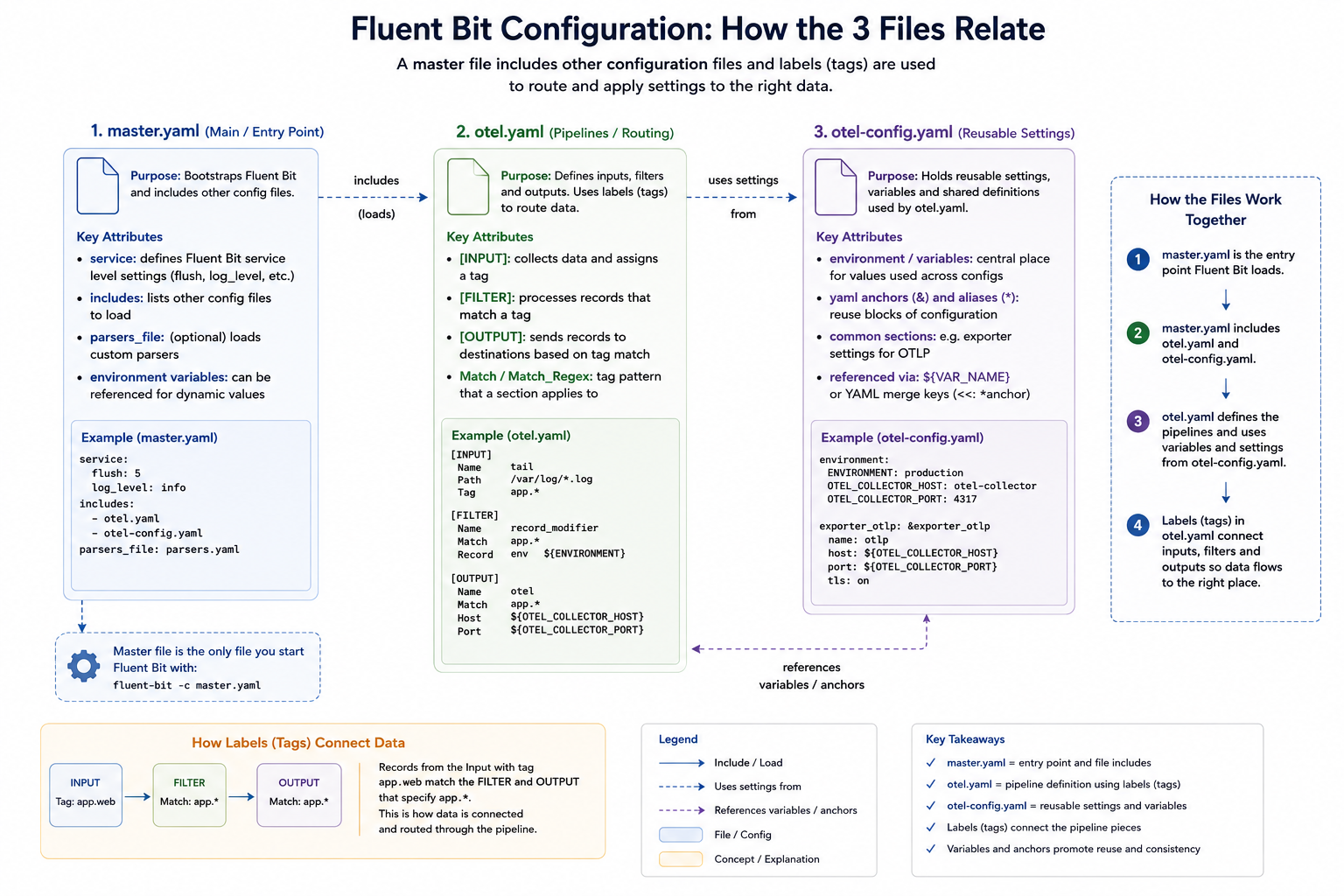
Our configuration consists of several files, which we’ll explain. We’ve adopted a multi-file setup, which works through the use of Fluent Bit’s includes capability so we can separate out the application-level observability configuration (master.yaml), the configuration to allow us to observe Fluent Bit itself (otel.yaml), and the configuration for the connection parameters (otel-config.yaml).
The master.yaml contains our application observability settings and is the configuration file we pass to Fluent Bit. In this case, we’re simply using a dummy input that’s fed to a file output; we’ve also got a wildcard stdout configuration to make it easy to observe what’s going on from the command line.
includes:
  - otel.yaml

service:
  flush: 1
  log_level: debug
  http_server: ${http_server}
  http_listen: ${http_listen}
  http_port: ${http_port}
  log_file: ${log-file}

pipeline:
  inputs:
    - name: dummy
      tag: dummy.activity
      dummy: '{"message":{"msg":"grafana-cloud test event","service":"fluent-bit","source":"dummy"}}'


  outputs:
    - name: stdout
      match: "*"
      format: json_lines

    - name: file
      match: "dummy.*"
      file: dummy.log
There are at this level, two telltale signs of self-monitoring at this level:
We’ve separated the pipeline definitions for Fluent Bit observability to reuse the configuration across many deployments. As different deployments may need to talk to different instances of the observability backend (for example, when operating in a multi-cloud arrangement we have defined the environment variables that provide the credentials and target address).
We have defined additional environment variables at this level, so that anyone needing to understand master settings and the service values needs only look here. How this layer (or layers) is established is, to an extent, concealed. It also means we can use OpAMP to generate a configuration file, but we’ll come back to that.
includes:
  - otel-config.yaml

env:
  http_server: on
  http_listen: 0.0.0.0
  http_port: 2020
  log_file: ${own-log-file}

pipeline:
  inputs:
  - name: fluentbit_metrics
    tag: fb.metrics

  - name: tail
    path: ${own-log-file}
    tag: ${own-log-file}

  outputs:
  - name: opentelemetry
    match: "*"
    host: ${otel-host}
    port: 443
    http_user: ${otel-user}
    http_passwd: ${otel-password}
    logs_uri: ${own-otel-logs}
    metrics_uri: ${otel-metrics}
    traces_uri: ${otel-traces}
    tls: on
    tls.verify: off
    log_response_payload: true
    logs_body_key: message
    add_label:
      - environment dev
      - destination grafana-cloud
The environment variables that we define to be used by the master.yaml switch the HTTP server on, and indicate which ports to use. Making this easy to check for the person or people defining the master.yaml makes it easier to avoid port collisions.
We also tell Fluent Bit where to write its logs through the service setting. To consolidate the configuration, that value references a different environment variable, so we can put all of our configurations together. Even if we didn’t have this level of redirection, it is worthwhile setting the value using an environment variable as the file location is needed both as our output for the service and the input for a plugin.. As you can see, we’ve just named the file. So the file created will be relative to wherever we run Fluent Bit from.
Let’s look at the inputs and outputs being used, and what they do:
That is the hard bit done. As a result of these inputs, we get the metrics and logs (and no traces are available). We now just need an OpenTelemetry output plugin to direct all the OTLP-represented signals. For simplicity, we’ve made use of a free account on Grafana Cloud.
This configuration file is simple, which is key to making it easy for us to manage the connections setup using OpAMP. It simply defines the connection-based attributes needed, as shown:
env: otel-user: '-my Grafana Cloud Accound Id-' otel-password: '-my Grafana Cloud Account Token-' otel-logs: '/otlp/v1/logs' otel-metrics: '/otlp/v1/metrics' otel-traces: '/otlp/v1/traces' own-log-file: 'flb.log' otel-host: 'otlp-gateway-prod-gb-south-1.grafana.net'
While populating credentials in a file isn’t ideal, it makes it pretty straightforward for an OpAMP Client (observer or supervisor) to receive the credentials for the management side of the protocol, make them available to Fluent Bit quickly, and have Fluent Bit pick them up dynamically via hot-deploy functionality. This is precisely what we have implemented in our OpAMP. This approach works for both Fluent Bit and Fluentd configurations and we can even apply a similar approach for driving clients such as Elastic Beats.
This configuration file is simple enough that we can rewrite it whenever the configuration values are amended; there is no complexity in inserting such settings into the broader configuration. Furthermore, if Fluent Bit were running as an observed process rather than a supervised (i.e., child) process, setting environment variables could become problematic.
We can mitigate credential-related challenges in the file system by restricting filesystem permissions to the file being written, so only certain users and processes can access it. When working with containers, we can also keep this part of the file system within the image by using a transient storage layer.
An alternative approach would be for the client to receive the credentials and store them in an encrypted method, such as a credentials vault, and then the launcher for the process would read and decrypt the file as it launches Fluent Bit or another collector. The way we have implemented the client for our OpAMP certainly makes this possible, but it also complicates the process and suggests that the mechanics of credential management would be better handled by a distributed vault solution.
The only niggle, is that when passing the connections, the protocol assumes that connection details are only needed for the collector. That’s fine if the collector includes the client side of the protocol. But as we know, the collector may be managed with a supervisor or observer process. We could use the connection for the collector and our supervisor, but that may not be what is wanted.
We can visualise the relationships, like this:
As you start to think about the server aspect of this, it gets potentially very complex. In simple scenarios, sending everything to a single Observability backend isn’t an issue.
But if you’re managing a multi-cloud, hybrid, or managed client setup, you’re likely to want separate backend instances for different collectors. In our setup, that means passing the different connection details to the client to populate otel-config.yaml. Understanding this deployment will require understanding the distribution. We will also need to manage potentially a concentrated catalogue of credentials, which will need to map to the collector nodes, and a means for the user to define the mapping. Creating a means to visualise the mapping, and ideally to allow the server to apply rules or infer assignments for more complex use cases such as multi-cloud, isn’t going to be simple.
We have a simple means to deploy configuration and observe our collector and the supervisor/observer process. Making server-side management in a large-scale environment easy to work with will require some consideration and potentially additional optional metadata. But the protocol supports all of this, but doesn’t mandate specifics. Which does mean that either the server has to be smart enough to know when what to do if it interacts with a client that has been built or configured to work with this server – which is an essential requirement, otherwise we lose the value of the
17 Friday Jul 2026
Posted in Fluent Observability, OpAMP, Technology
Tags
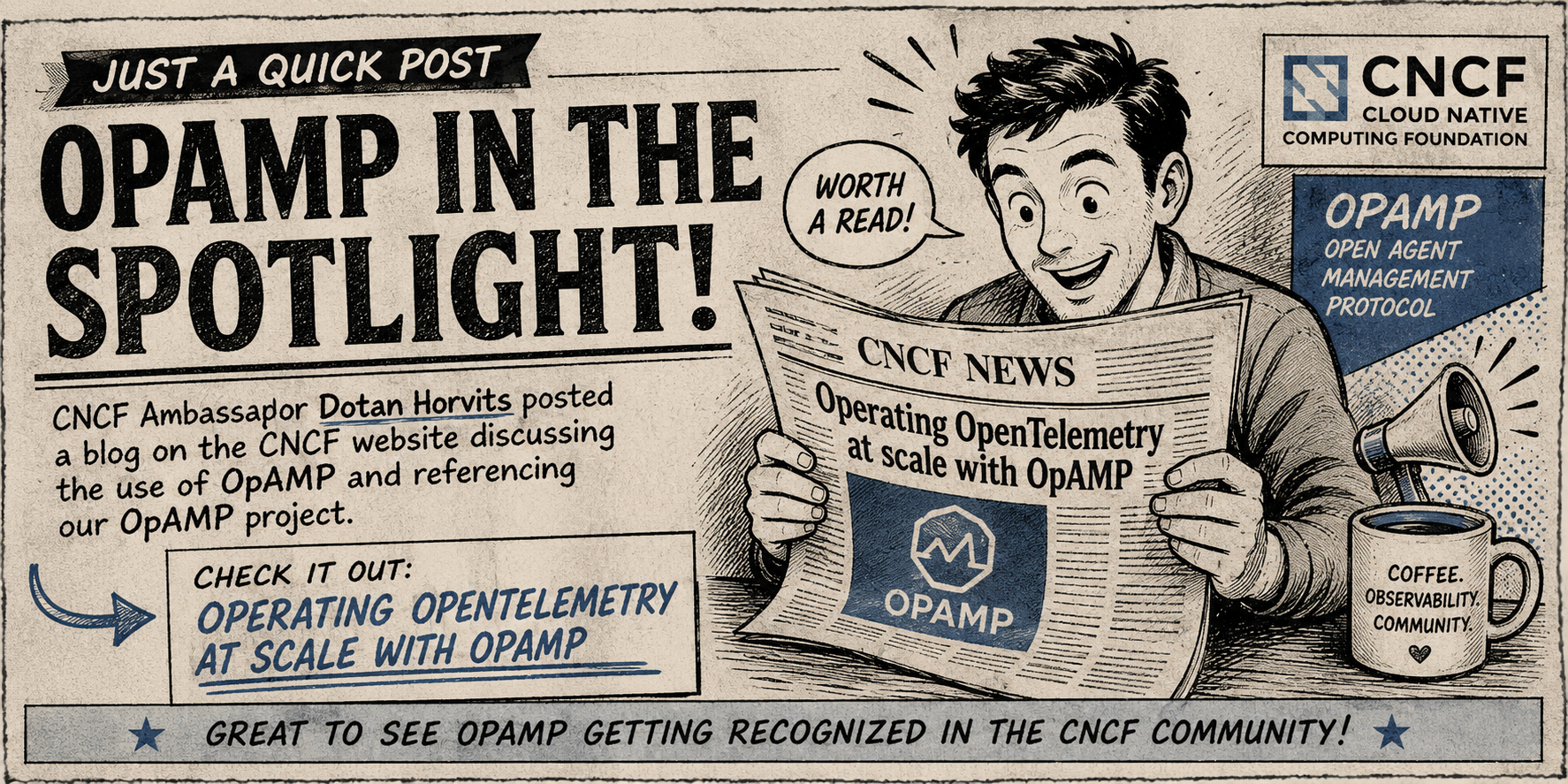
Just a quick post: CNCF Ambassador Dotan Horvits posted a blog on the CNCF website discussing the use of OpAMP and referencing our OpAMP project. Check it out at Operating OpenTelemetry at scale with OpAMP. Ignoring the work we’ve been doing, it’s an interesting read.
15 Monday Jun 2026
Posted in Fluent Observability, General, OpAMP, Technology
Tags
AI, artificial-intelligence, development, Fluent Bit, LLM, MCP, OpAMP, open telementry, Technology
So we’ve been busy working on our OpAMP solution. We’ve made a number of enhancements since we labelled the code v0.4 back in April. For this post, we’ll look at the features added and where we’re looking next.
For a start, we demo’d what has been developed as part of CNCF Webinar about OpAMP
There has been a lot of feature development, particularly in support of working with Fluent Bit (and to a degree Fluentd).
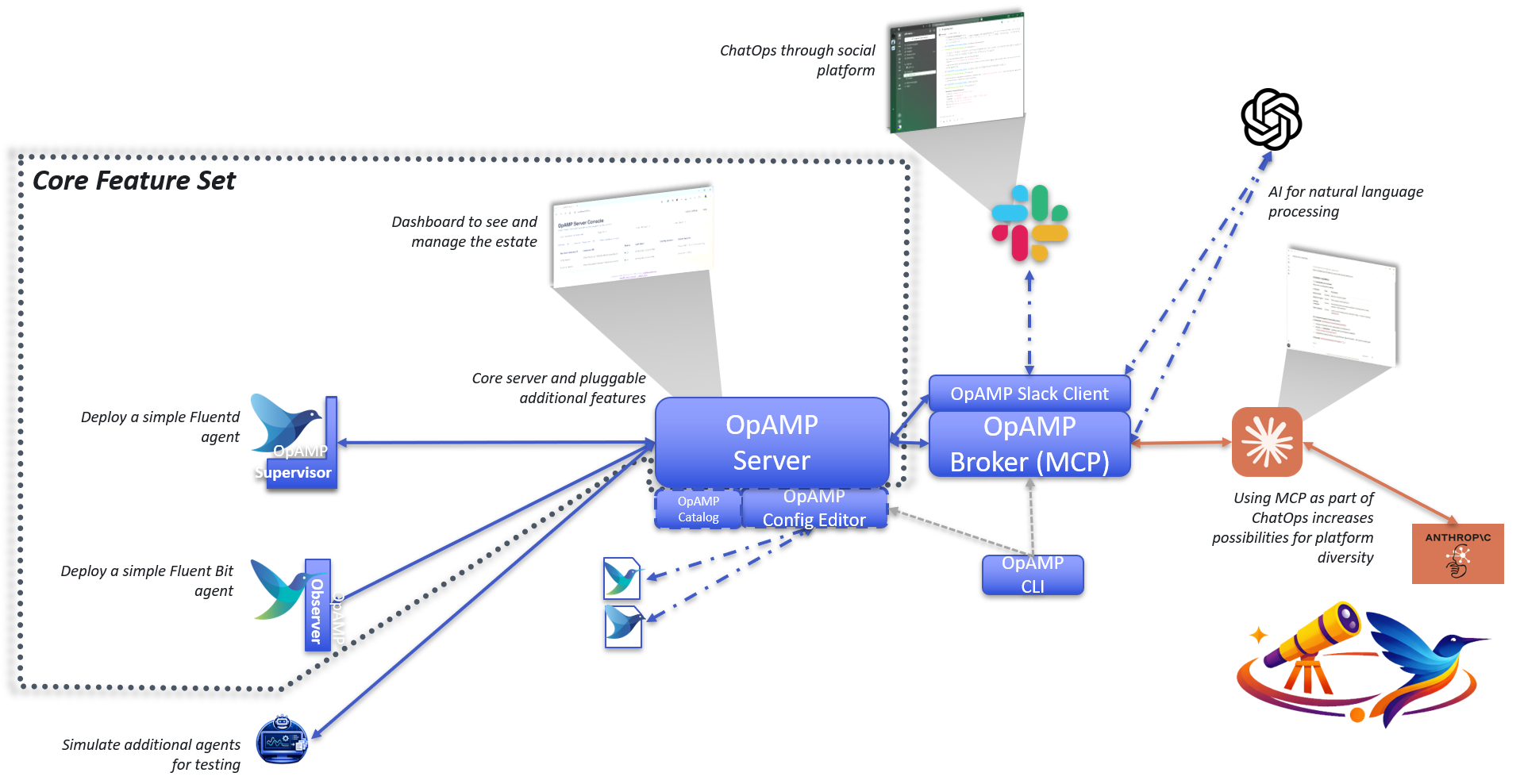
We started building the Configuration Editor as a standalone capability. The thinking was that we would refactor it into the OpAMP server once we were happy with the functionality and had progressed far enough. But, as we saw this come together, it occurred to me that both deployments are good, as part of the OpAMP server, seeing the configuration being used is handy, but having a freestanding editor (without worrying about the connectivity to communicate with agents) is also a real use case.
So we have created the setup, where if the OpAMP is told to look for the Editor via the definition of Python endpoints in the configuration and it is deployed, it will be incorporated into the server. If the editor isn’t provided (deployed, or not identified in the configuration it isn’t offered in the navigation.
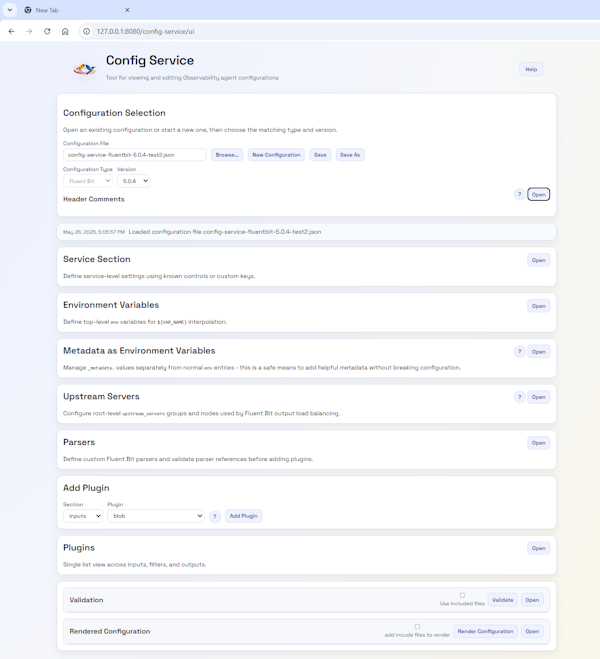
The editor is completely configuration-driven through JSON, so it only requires extending the JSON to support custom plugins or to enhance the validation rules (e.g., adding a REGEX to how a particular parameter is set). This far outweighs the current Dry run checks.
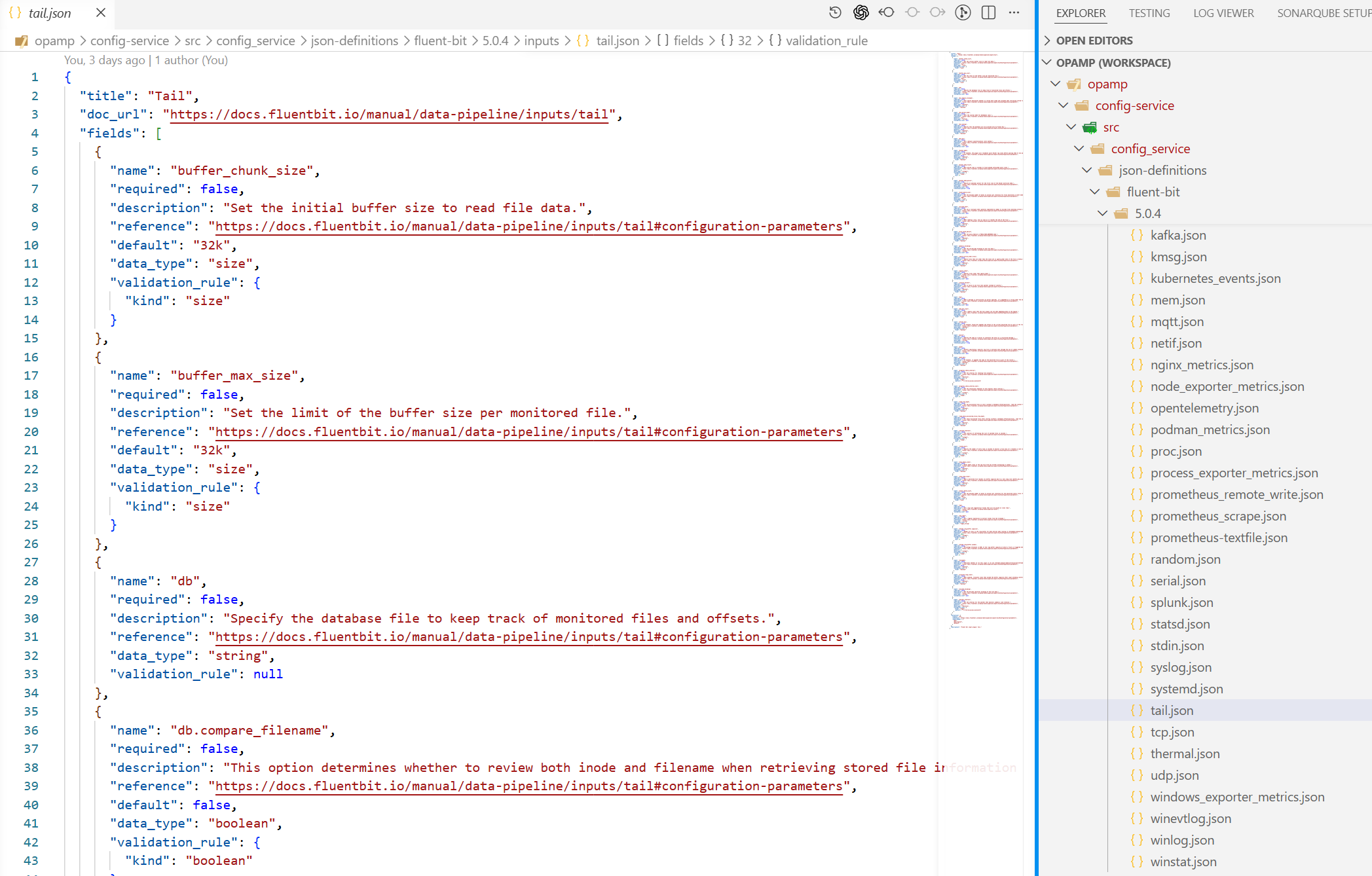
The configuration is considerable, so we refactored the structure to make it far easier to work with, and created some code that can mine Fluent Bit’s GitHub to generate an initial clean set of JSON docs. Of course these need an eyeballing to ensure they’re correct.
The catalogue viewer is a natural extension of the editor and leverages the way we tag configuration files with version details in the editor. The catalogue viewer has a configuration which tells it where to look for candidate files. These are then listed with the metadata.
The catalogue viewer presents all the identified files, which, when selected, if it knows about the config editor, will open the editor with the file. Otherwise, it opens a simple view of the file.
The catalogue viewer works in the same way as the editor in terms of authentication.
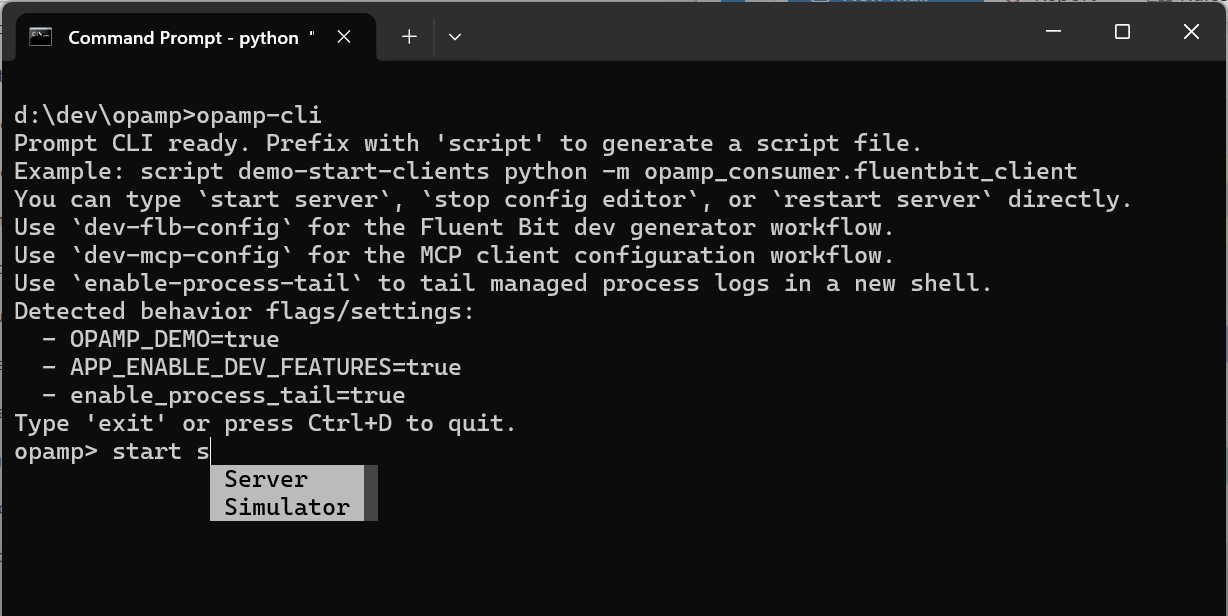
A Command Line tool maybe and odd choice of feature, but we found ourselves creating more and more scripts to support Windows and Bash shells with commonality. So we elected to leverage some frameworks to help reduce the ongoing effort required to maintain them. The utility can be used to generate the command, if you wanted embed the process of starting or stopping a process into the host OS.
The OpAMP documentation suggests that the agent logic is embedded, or wrapped with a supervisor, with the inference that the agent forks the application process. This means that introducing the OpAMP would be invasive. There is a noninvasive variant of the Supervisor that we’ve called Observer. Here, the agent know how to identify the key process by examining the host’s processes. Then tasks such as restarting require an understanding of how to get the OS to trigger, for example, if the service is known to init.d in Linux, we can use the service command.
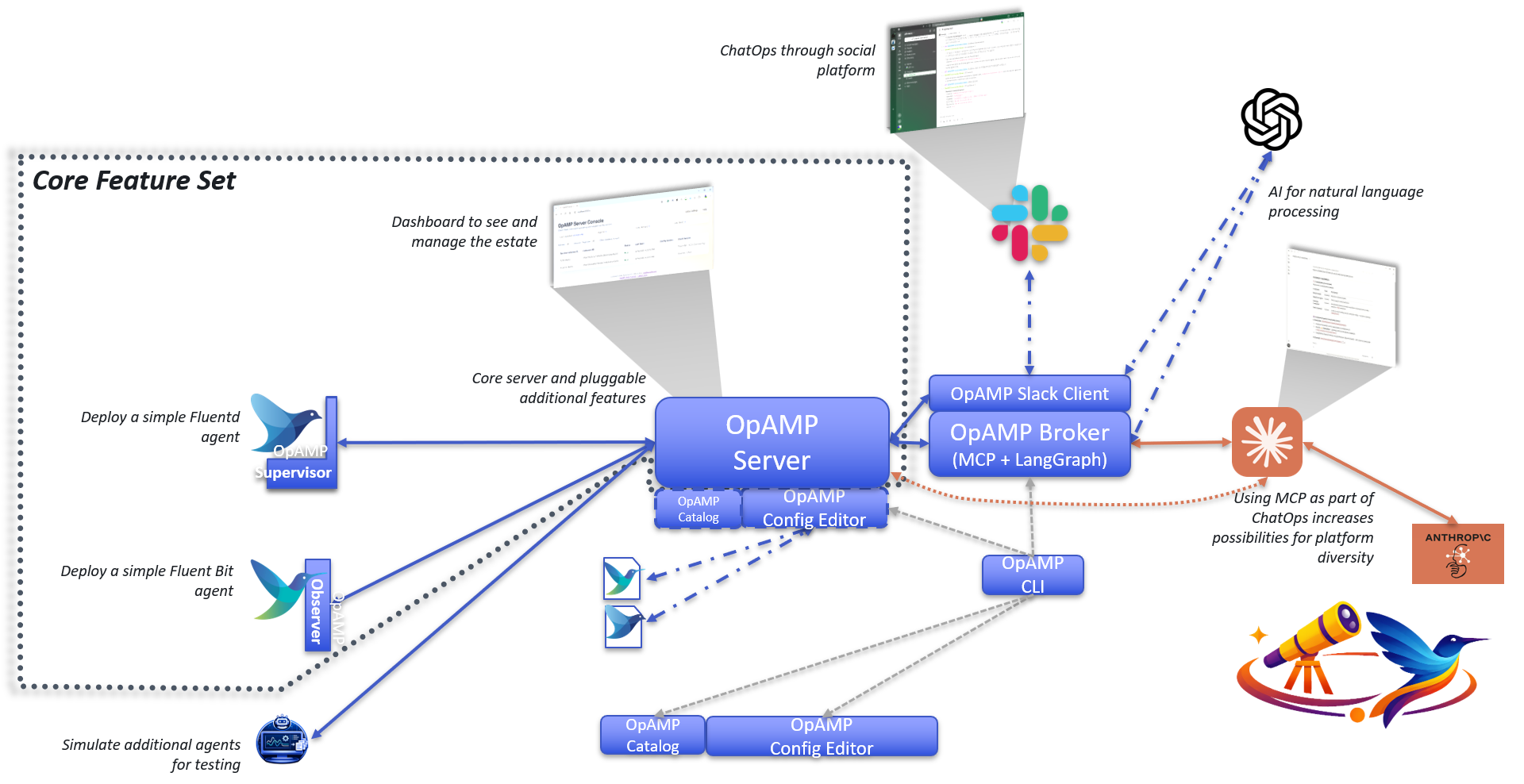
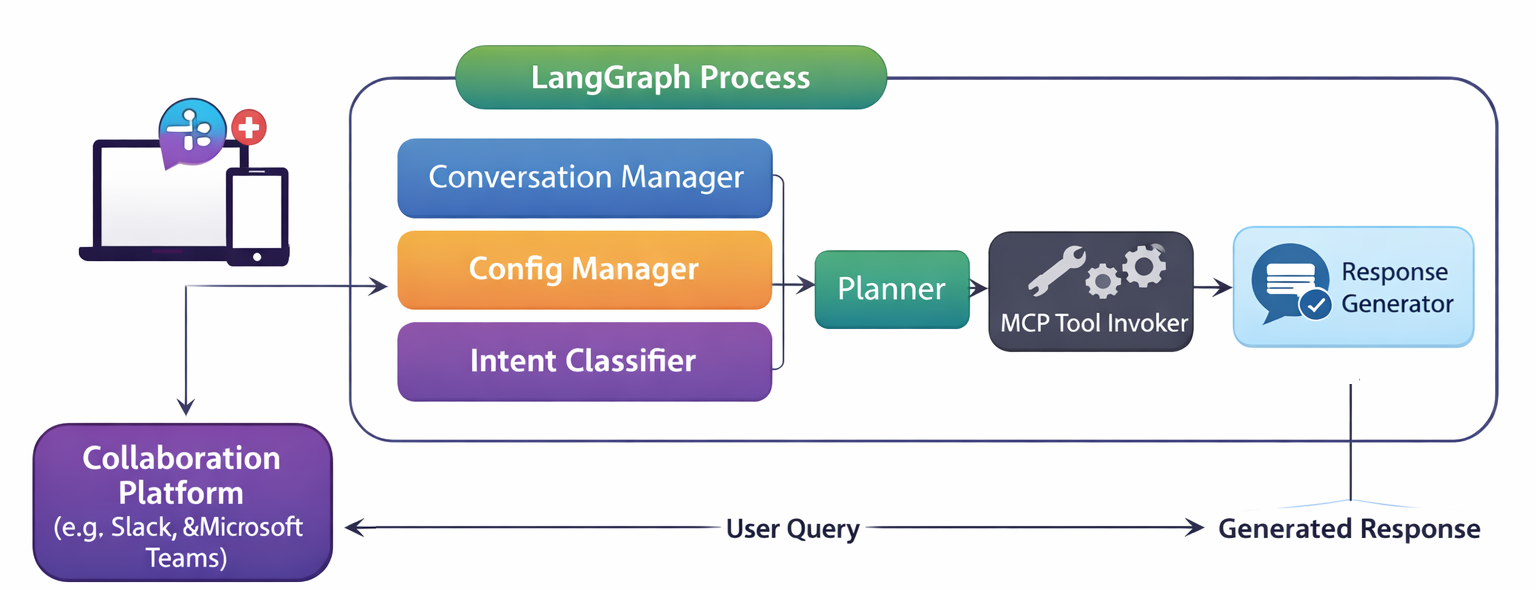
We’ve got the Slack foundations progressed, so we can use natural language VIA langgraph to then work with MCP, which exposes a subset of API capabilities. We’ve developed both the main server and the Broker to support the MCP endpoints, with the Broker acting as a proxy to the regular Server APIs. This means if we want the MCP to be usable from outside our network, then we can separate the Broker and Agent into separate networks so that the wider set of endpoints the server provides aren’t exposed.
But if you don’t want that the MCP endpoint can be switched on.
We have started to address the foundations of managing configuration deployment (for example, if our Catalogue Service is used with the Server, it can be used to select the configuration files to deploy.
Part of config deployment is understanding what is deployed, so we have developed some strategies for versioning Fluent Bit and Fluentd, and I think it will translate to other configuration files (at least into the Observability space).
What we haven’t done is fully implement the process. So we’ll focus on that
There is a lot of functionality here now, including tests with Playwright, but we really need to extend it to provide end-to-end tests in a clean environment that is set up from the various pip and wheel files.
We also want to start making these artefacts easier to retrieve, such as pulling the Wheel or PIP files from GitHub or PyPi.
02 Tuesday Jun 2026
Posted in Fluent Observability, General, OpAMP, Technology
A short post, I’m excited to share that I will be presenting a Webinar for the CNCF Malaga meetup on the 11th June 6.30pm CEST where I’ll be talking about OpAMP – registration link.
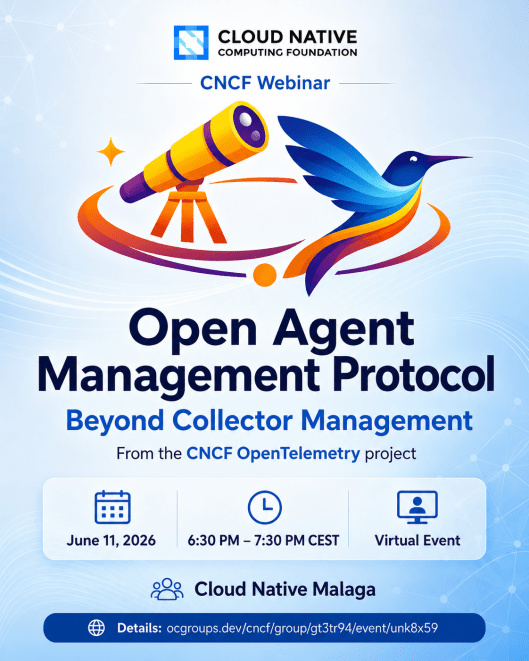
I hope you can join me to hear about the value of the OpAMP protocol, which originated from the CNCF OpenTelemetry project. I’ll be talking about what the protocol can do for us, how it works, and while it has origins within the OpenTelemetry project, it has far-reaching value for almost any deployment context.
This isn’t all theory, I’ll be demoing the functionality we’ve built that leverages the OpAMP spec. While the focus will be on Fluent Bit, it will convey the value of the protocol. We’ll also look at how it can scale in both volume and the range of client applications it can support.
27 Wednesday May 2026
Posted in Fluent Observability, Fluentbit, General, OpAMP, Technology
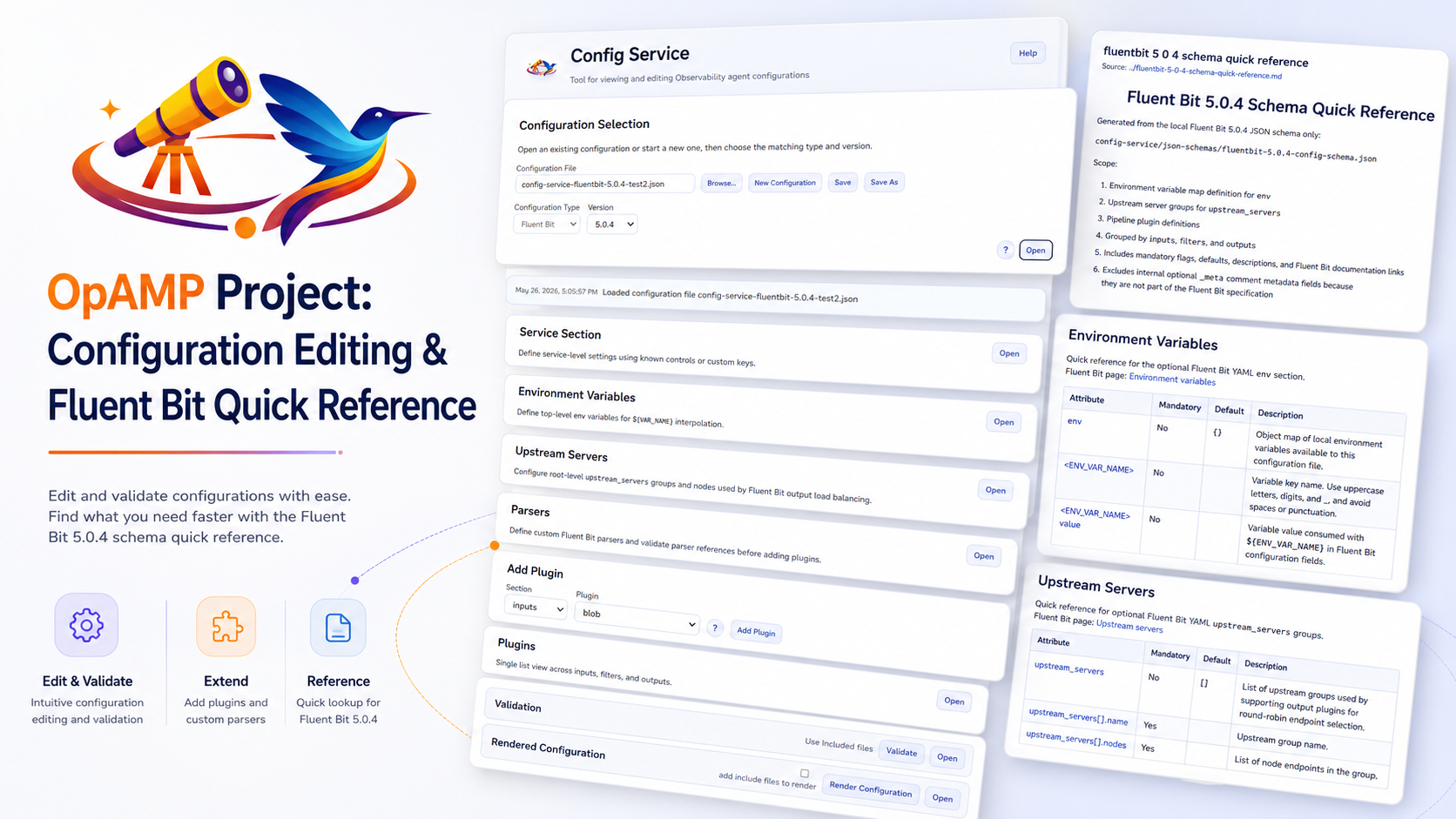
Fluent Bit’s documentation is spread across many static web pages; in some cases, attributes allowed for a plugin are documented across several pages. There is absolutely nothing wrong with this. Having written a book on Fluent Bit, I can say it makes sense, and if the standard docs went into further detail, it would increase the spread of content.
The problem is, once you’ve got a grip on Fluent Bit, you want a quick reference just to check the attribute names or confirm that an attribute does what you expect.
The good news is that’s what we have created …
Each quick reference page has a section at the top that provides a comma-separated list of all the plugins for the different operations, inputs, outputs, etc., with anchor links to that section. Each plugin has a table that lists all configuration attributes, including those inherited from the Fluent Bit kernel and those introduced by extending another plugin.
The “why” may prove even more appealing. As part of our OpAMP project, we wanted to make it easy to edit and validate Fluent Bit and Fluentd configurations before deployment using the OpAMP tooling. That tool became the config-service part of the OpAMP repo, and can be independently deployed as well as function as part of the main OpAMP service. As a result, the UI offers the same authentication and authorisation options, ranging from running without authentication to using OAuth.
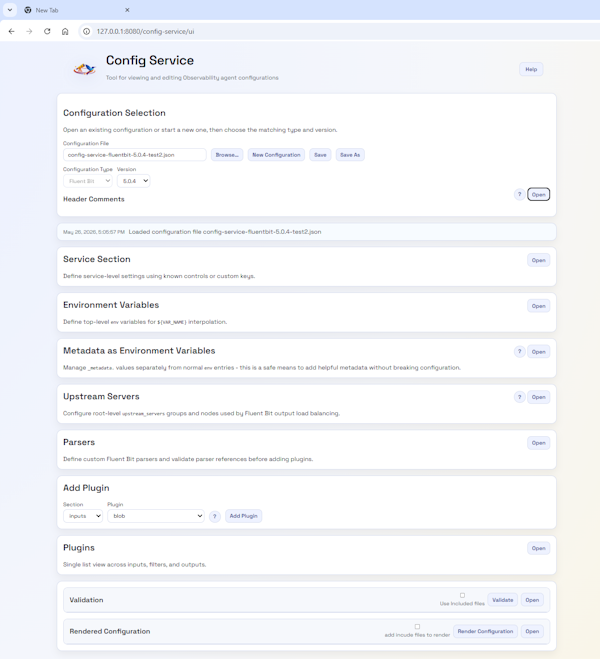
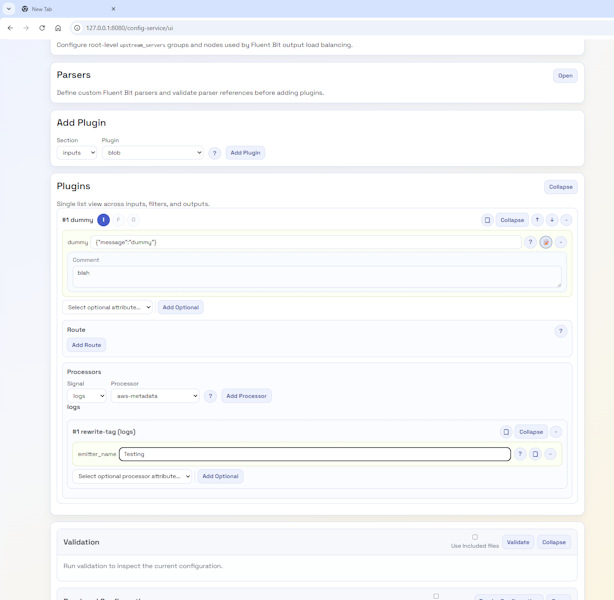
The key to both the UI and documentation is the use of JSON Schemas, as they contain all the information needed to create documentation just as easily as they power the UI. We have therefore generated a markdown page using a Python script. This means the docs are easy to check (compared to an HTML file) and can be rendered within GitHub. We could extend the script to generate HTML. But rather than trying to remember to keep both document types in sync (and double-check formatting), we found a JavaScript tool (marked.js) that performs an on-the-fly transformation that, as long as we stay within the core Markdown syntax, won’t cause any issues. We’ve then enriched that output a bit by applying stylesheets.
At the moment, we have only covered a subset of Fluent Bit versions, so we will, in due course, expand to cover more versions. Today, this is just the last version from each major release. We haven’t done every version to date as it does take a lot of effort to go through the documentation to generate and check the schema, and we’re still refining things as we enhance the UI.
We are also looking to do the same for Fluentd, though this is much trickier, as the portfolio of plugins that make up the core is smaller than those incorporated into the core of Fluent Bit, and the leveraging of Ruby’s dynamic behaviour makes it very easy for people to offer plugins separately. Then, of course, there is the task of collating all that information.
08 Friday May 2026
Posted in Cloud Native, development, Fluent Observability, Fluentbit, Fluentd, General, OpAMP, Technology
Tags
AI, artificial-intelligence, configuration, development, ELK, Fluent Bit, Fluentd, LLM, observability, OpAMP, Technology
Something that vendors like Microsoft have been really good at is reducing the friction on getting started – from simplifying installations with MSI files and defaulted options through to very informative error messages in Excel when you’ve got a function slightly wrong. Apple is another good example of this; while no two Android phones are the same, my experience is that setting up an iPhone is just so much easier than setting up an Android phone. It is also the setup/configuration where most friction comes from.
Open-Source Software (OSS), as a generalisation, tend to be a bit weaker at minimising friction – this comes from several factors:
The issue that I have observed is that we often go through cycles of working with a technology. For example, you’re building a microservice. Chances are, you’ll start writing and running it locally, without worrying about containerization. Once you’re pretty happy with things, you’ll Dockerize the service, start testing it locally, and then you’ll be ready to deploy it to a cluster. Now you’ll need your YAML. It may well be weeks since you last looked at Helm charts. You end up cutting and pasting your last configuration. But now you need to use another feature of Helm, can you remember the exact settings for the feature. So now you’re trawling the net for documentation, and then it takes several tries to get it right.
AI may well step in to help developers in this area, where solutions and products are well-documented. But with the wrong model or insufficient detail in the prompt, it’s easy to make a mistake. Personally, I’d turn to AI when it becomes necessary to trawl code to better understand the configuration and its behaviour, and to set options.
Solution – well, that depends upon the configuration syntax. We have been experimenting with RJSF (React JSON Schema Form), which provides a React-based UI that can be dynamically driven by a JSON schema and validate data with AJV (an alternative stack considered would have been around JSON Forms).
{ "type": "object", "title": "Dummy", "properties": { "name": { "type": "string", "const": "dummy", "title": "Plugin" }, "copies": { "type": "integer", "description": "Number of messages to generate each time messages are generated.", "x-doc-reference": "https://docs.fluentbit.io/manual/data-pipeline/inputs/dummy#configuration-parameters", "x-doc-required": false, "x-config-data-type": "integer", "default": 1 }, "dummy": { "type": "string", "description": "Dummy JSON record.", "x-doc-reference": "https://docs.fluentbit.io/manual/data-pipeline/inputs/dummy#configuration-parameters", "x-doc-required": false, "x-config-data-type": "string", "default": "{\"message\":\"dummy\"}" }, "fixed_timestamp": { "type": "boolean", "description": "If enabled, use a fixed timestamp.", "x-doc-reference": "https://docs.fluentbit.io/manual/data-pipeline/inputs/dummy#configuration-parameters", "x-doc-required": false, "x-config-data-type": "boolean", "default": false } }}
The above fragment shows part of the Schema definition for the Dummy plugin for Fluent Bit.
By then creating a schema that defines the different plugins, attributes, etc., we can drive validation and menu items easily in the UI. Admittedly, the config file is significant given all the plugins and configuration options, but it is a fair price to pay for a UI that validates the data. Establishing the schema to start with, we’ve covered it through scripting the retrieval and scraping of the Fluent Bit pages, which are pretty consistent in structure.
We have added some custom elements into the definition, for example, x-doc-reference, which allows us to extend the React components to provide features such as a link back to the original documentation as you select attributes or plugins.
As a result, we very quickly have a UI that can look like this:
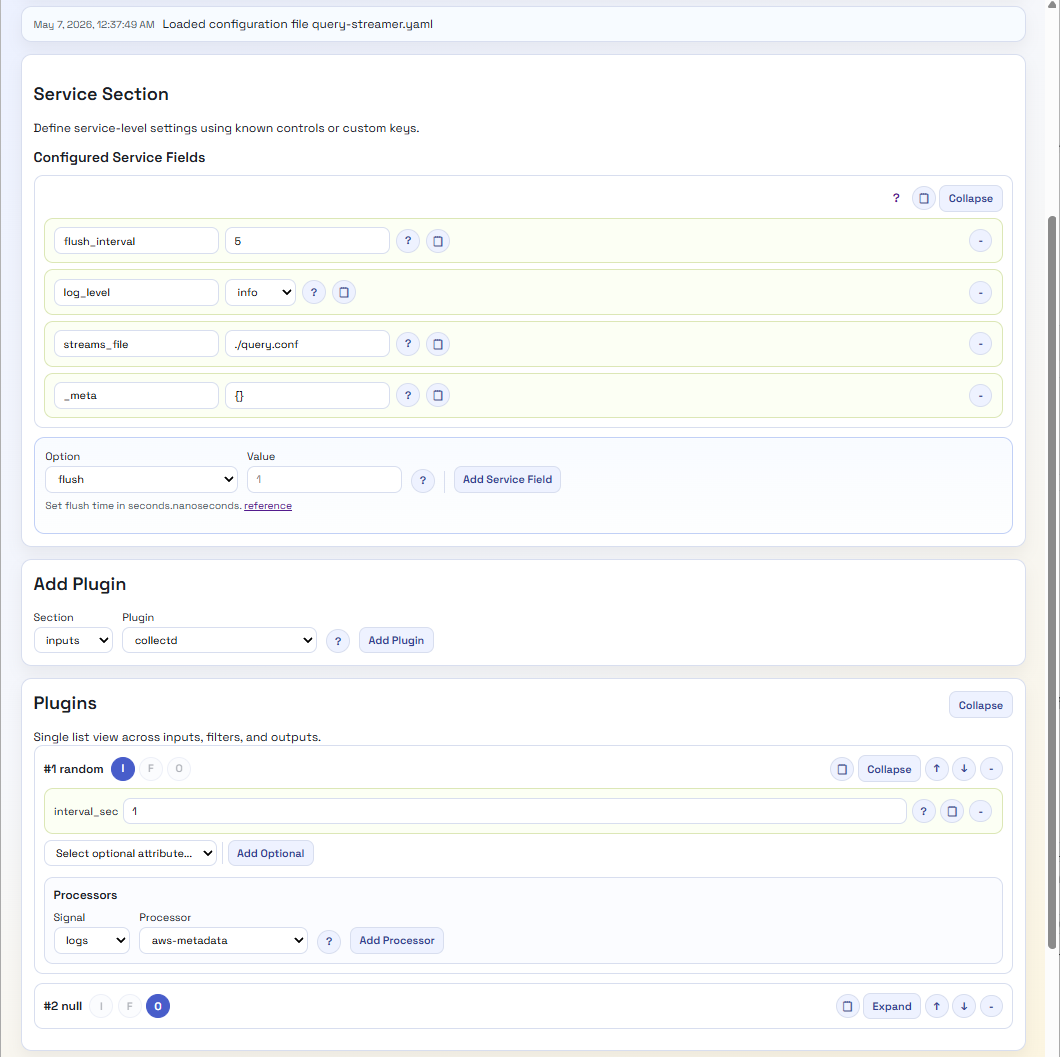
A lot easier to view and tweak, with no need to hunt for valid options. Even if we want more information, we’re just a button click away from the open-source data. Perhaps we should provide a version that hyperlinks to the Manning Live Books on Fluent Bit, etc.
There are a few other factors to consider; for example, Fluent Bit configuration is YAML, not JSON, which can be easily resolved given the relationship between the two standards. Then there are processors that can embed Lua code or a SQL-like syntax. As we’ve chosen to provide a Python backend, we’ve addressed this by providing REST endpoints which can query out of the JSON the code or SQL and perform validation using the Python Lua Parser, and the SQL syntax can be addressed using the Lark library for processing the SQL, as the syntax is simple enough to define and maintain the syntax.
We still need to address several features that Fluent Bit has, specifically:
These issues should be straightforward to overcome, although dynamically including the included elements into the UI view elements can be done. The challenge is: if any changes need to go into something that has been included, how do we push them back to the included file? Particularly if there are multiple layers of inclusion.
Fluentd configuration isn’t JSON-based notation, but it is structured. So, to apply the same mechanism, we’ll need to define a schema and a mapping mechanism. The tricky part of the schema is that Fluentd supports nesting plugins, since the way pipelines are defined for routing differs. While JSON schema will enable this with constructs such as anyOf, oneOf, object nesting, and bounded object arrays, the structure will be more complex.
The second challenge will be the transformer/renderer, so we don’t introduce issues from having to escape and unescape characters, since JSON Schema is stricter about character use.
Well, if we get this going, we’ll probably incorporate the capability into our OpAMP project and maybe create a build that lets the configuration tool run independently. Lastly, perhaps we should look to see if we can make the different layers a little more abstract, so we can plug in editors for other configurations, such as OTel Collectors or the ELK Stack.
As a bonus, perhaps transform the Schema into a quick reference web document?
14 Tuesday Apr 2026
Posted in AI, chatbots, development, Fluent Observability, General, OpAMP, Technology
I’ve written a few times about how OpAMP (Open Agent Management Protocol) may emerge from the OpenTelemetry CNCF project, but like OTLP (OpenTelemetry Protocol), it applies to just about any observability agent, not just the OTel Collector. As a side project, giving a real-world use case work on my Python skills, as well as an excuse to work with FastMCP (and LangGraph shortly). But also to bring the evolved idea of ChatOps (see here and here).
One of the goals of ChatOps was to free us from having to actively log into specific tools to mine for information once metrics, traces, and logs reach the aggregating back ends, but being able to. If we leverage a decent LLM with Model Context Protocol tools through an app such as Claude Desktop or ChatGPT (or their mobile variants). Ideally, we have a means to free ourselves to use social collaboration tools, rather than being tied to a specific LLM toolkit.
With a UI and the ability to communicate with Fluentd and Fluent Bit without imposing changes on the agent code base (we use a supervisor model), issue commands, track what is going on, and have the option of authentication. (more improvements in this space to come).
With the first level of the new ChatOps dynamism being through LLM desktop tooling and MCP, the following are screenshots showing how we’ve exposed part of our OpAMP server via APIs. As you can see in the screenshot within our OpAMP server, we have the concept of commands. What we have done is take some of the commands described in the OpAMP spec, call them standard commands, and then define a construct for Custom Commands (which can be dynamically added to the server and client).
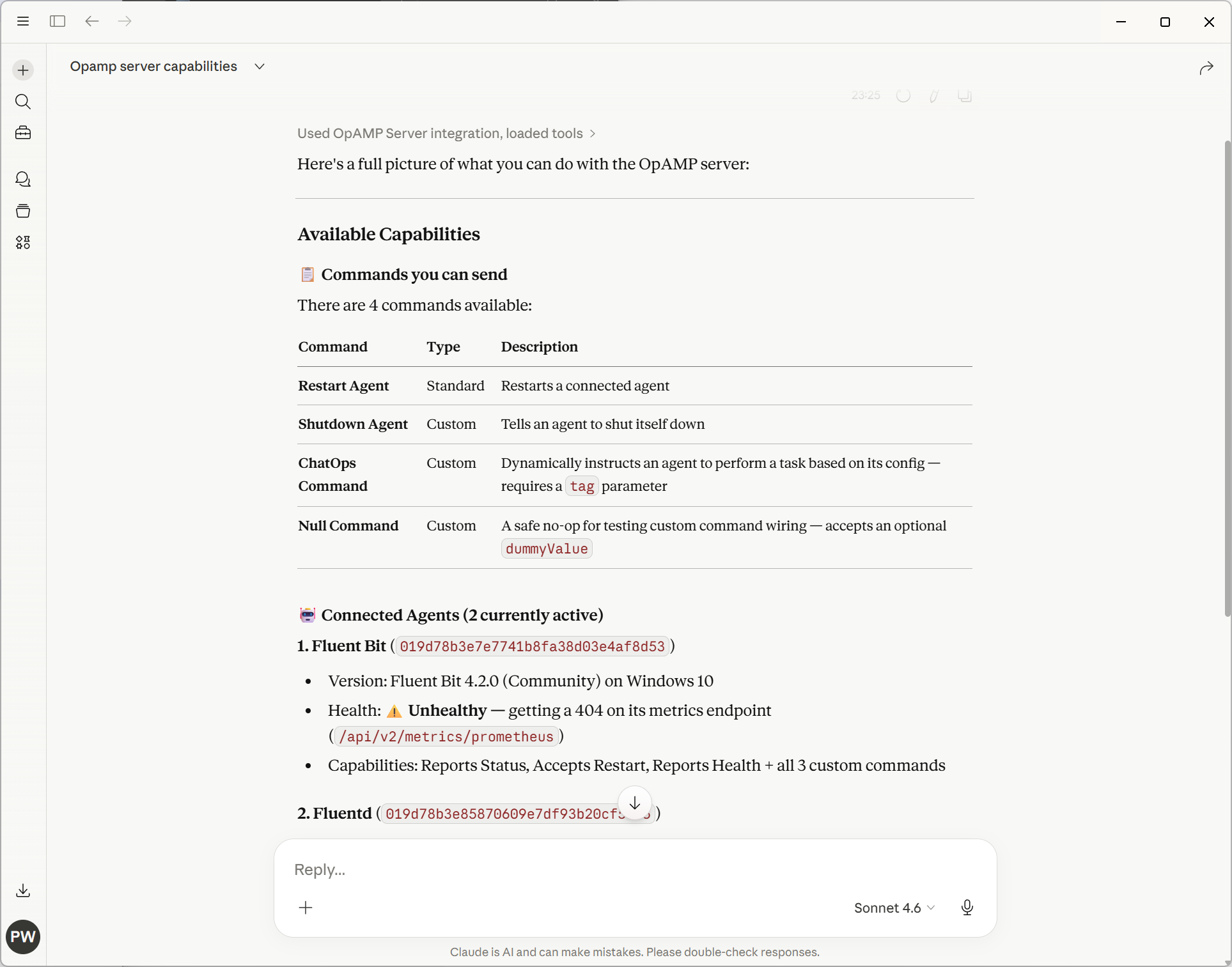
The following screenshot illustrates using plain text rather than trying to come up with structured English to get the OpAMP server to shut down a Fluentd node (in this case, as we only had 1 Fluentd node, it worked out which node to stop).
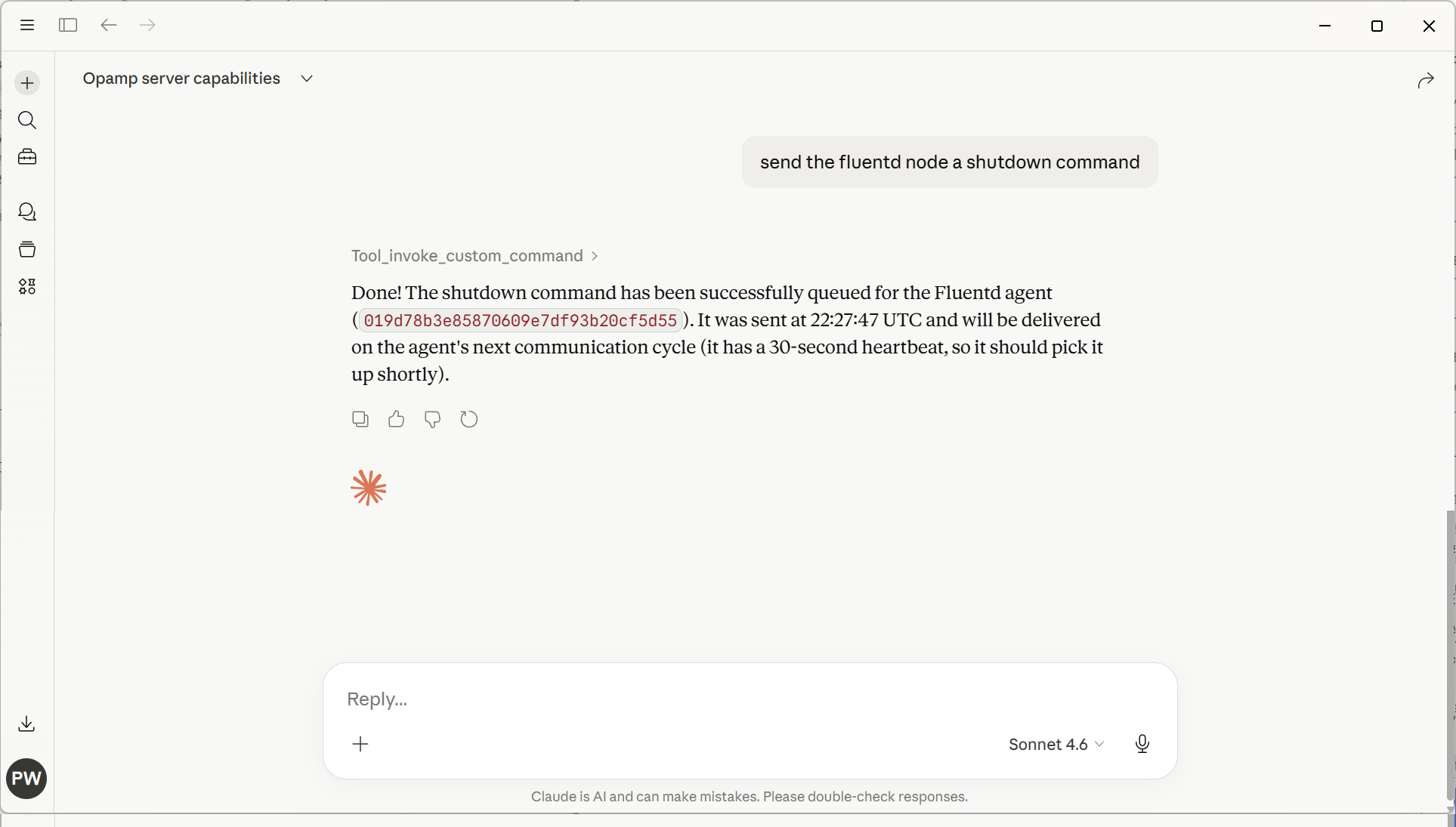
What will be interesting to see is the LLM token consumption changes as the portfolio of managed agents changes, given that, to achieve the shutdown, the LLM will have had to obtain all the Fluent Bit & Fluentd instances being managed. If we provide an endpoint to find an agent instance, would the LLM reason to use that rather than trawl all the information?
ChatGPT, Claude Desktop, and others already incorporate some level of collaboration capabilities if the users involved are on a suitable premium account (Team/Enterprise). It would be good to enable greater freedom and potentially lower costs by enabling the capability to operate through collaboration platforms such as Teams and Slack. This means the next steps need to look something along the lines of:
02 Thursday Apr 2026
Posted in Fluent Observability, General, Technology
Tags
API, Cloud, development, observability, OpAMP, OTel, Technology
Time to share a short update on our OpAMP project to support Fluent Bit and Fluentd in a supervisor model. We’ve just put a V0.3 label on the GitHub repo (https://github.com/mp3monster/fluent-opamp). The trigger for this has been the refactoring so that the framework on the client side is as reusable as possible for both Fluentd and Fluent Bit (the benefit of implementing Opamp using a supervisor model)
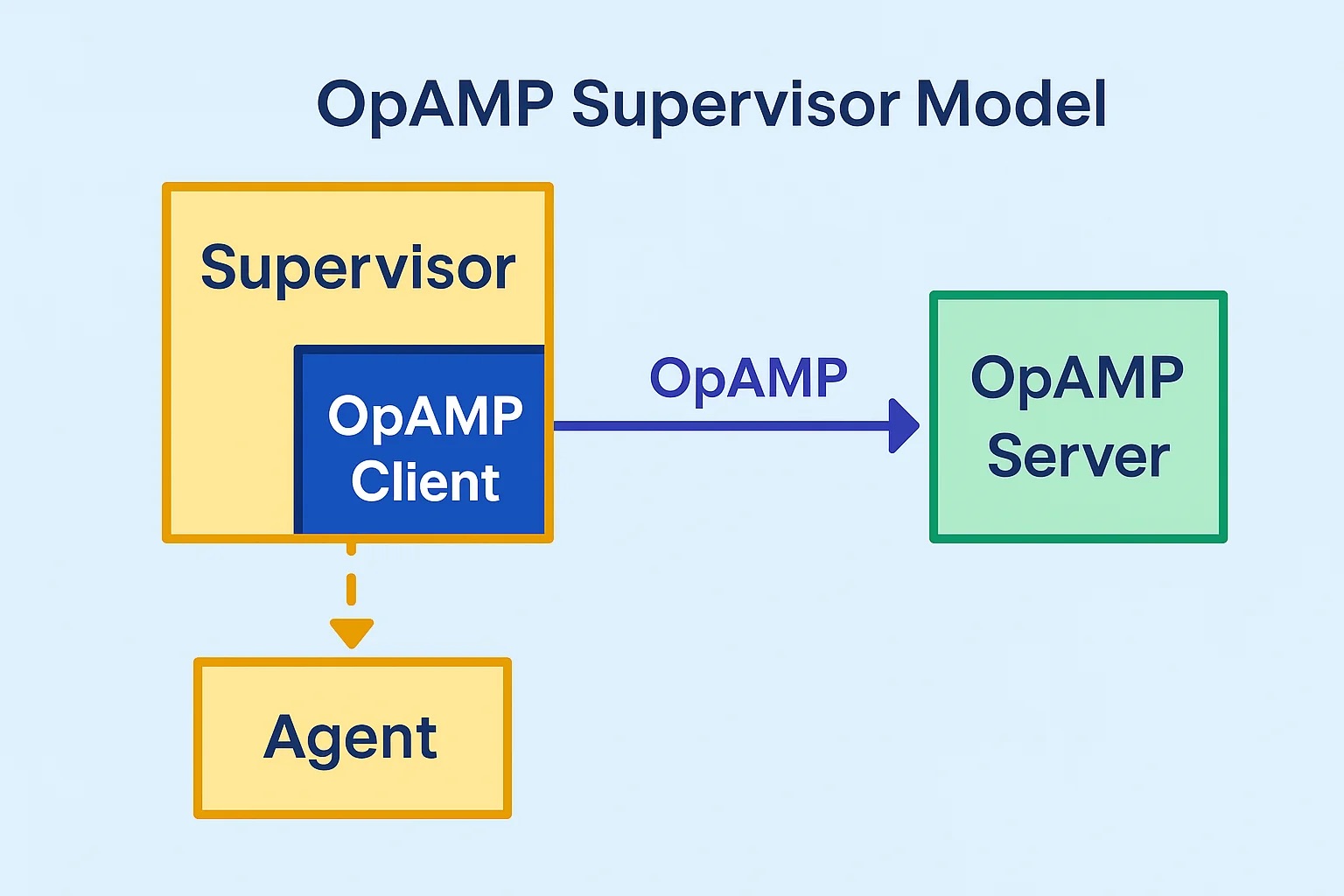
As OpAMP defines what happens between the Client and Server rather than how the client, server and agent must behave as well as the protocol we’ve introduced some features not mandated by the standard but can be delivered using the OpAMP framework. Such as shutting the agent down completely.
The following sections summarize what has recently been incorporated.
Over the last set of releases, we focused on three areas that matter in day-to-day operations:
This post is a walkthrough of what changed and why.
We restructured the consumer so Fluent Bit and Fluentd are now explicit concrete implementations built on a shared abstract client.
Before this work, behavior could drift toward Fluent Bit defaults in places where Fluentd needed different handling. The new structure makes those differences deliberate and visible.
fluentd.conf/YAMLWe’ve created scripts to make it easy to get things started quickly. The startup scripts were standardized:
scripts/run_fluentbit_supervisor.sh|cmdscripts/run_fluentd_supervisor.sh|cmdscripts/run_all_supervisors.sh|cmdWe added optional bearer-token auth for the UI and MCP end points in the server. The OPAMP spec points to different authentication strategies that need to be addressed. For bearer-token-managed endpoints (where you can direct the server to do things that are potentially much more harmful), the design goal is to keep development and unit testing simple, so we have some controllable modes..
Authentication is controlled by environment variables:
disabled (default): no auth checks.static: bearer token checked against a configured shared token.jwt: JWT bearer validation via JWKS (for example with Keycloak).Protection is prefix-based (for example /tool, /sse, /messages, /mcp) and configurable.
This means teams can gradually expand the scope of protection over time by updating path prefixes, rather than doing an all-or-nothing rollout.
Authorisation rejections are logged with mode, method, path, source, and reason, making failed requests easier to troubleshoot.
A major part of OpAMP behavior is deciding when to send compact updates versus a fuller state snapshot. We now fully observe the approach defined by OpAMP, but also have explicit controller-driven rules to provide robustness to the solution.
The client tracks reporting flags for optional outbound sections, such as:
agent_descriptioncapabilitiescustom_capabilitieshealthIf a flag is set, that section is included on send. After inclusion, the flag resets. Controllers determine when those flags are re-enabled for a future full refresh.
We support three controller types:
AlwaysSendre-enable all report flags after each successful send.SentCount: re-enable all report flags after N successful sends (fullResendAfter).TimeSend: re-enable all report flags after a configured elapsed interval.Controller updates happen after a successful send. This means a controller schedules what the next message should include; it does not mutate the already-transmitted message.
If the server sets ReportFullState in ServerToAgent.flags, the client immediately re-enables all reporting flags so the next outbound message contains full reportable state.
This gives operators a direct way to request state re-synchronization when needed.
A recurring theme in this work was avoiding “security vs usability” tradeoffs:
That same principle guided client behavior:
This foundation makes the next iterations easier:
If you’re running both Fluent Bit and Fluentd, this release should make the platform easier to operate, easier to secure, and easier to reason about under change.
23 Monday Mar 2026
Posted in Fluent Observability, Fluentbit, General, OpAMP
Tags
AI, artificial-intelligence, Cloud, Fluentbit, Fluentd, LLM, observability, OpAMP, Technology
With KubeCon Europe happening this week, it felt like a good moment to break cover on this pet project.
If you are working with Fluent Bit at any scale, one question keeps coming up: how do we consistently control and observe all those edge agents, especially outside a Kubernetes-only world?
This is exactly the problem the OpAMP specification is trying to solve. At its core, OpAMP defines a standard contract between a central server and distributed agents/supervisors, so status, health, commands, and config-related interactions follow one protocol instead of ad-hoc integration per tool.
That is where this project sits. We’re implementing the OpAMP specification to support Fluent Bit (and later Fluentd).
In this implementation, we have:
Right now, we are focused on Fluent Bit first. That is deliberate: it keeps scope practical while we validate the framework. The same framework is being shaped so it can evolve to support Fluentd as well.
The repository for the implementation can be found at https://github.com/mp3monster/fluent-opamp
The provider/server is the control plane endpoint. It tracks clients, accepts status, queues commands, and returns instructions using OpAMP payloads over HTTP or WebSocket.
The consumer/supervisor handles the local execution and reporting. It launches Fluent Bit, polls local health/status endpoints, sends heartbeat and metadata to the provider, and handles inbound commands (including custom ones). The server and supervisor can be deployed independently, which is important for real-world rollout patterns.
Because they follow the OpAMP protocol model, clients and servers can be interchanged with other OpAMP-compliant implementations (although we’ve not yet tested this aspect of the development).
Together, they give us a manageable, spec-aligned path to coordinating distributed Fluent Bit nodes without hard-coding one-off control logic into every environment.
There are a few practical ways to get started quickly:
scripts/run_opamp_server.sh (or scripts/run_opamp_server.cmd on Windows).scripts/run_supervisor.sh (or scripts/run_supervisor.cmd on Windows).The scripts will set up a virtual environment and retrieve the necessary dependencies.
If you want an initial MCP client setup as part of your workflow, there are helper scripts for that too:
mcp/configure-codex-fastmcp.sh and mcp/configure-codex-fastmcp.ps1mcp/configure-claude-desktop-fastmcp.sh and mcp/configure-claude-desktop-fastmcp.ps1Here is a first server view we can include in the post:
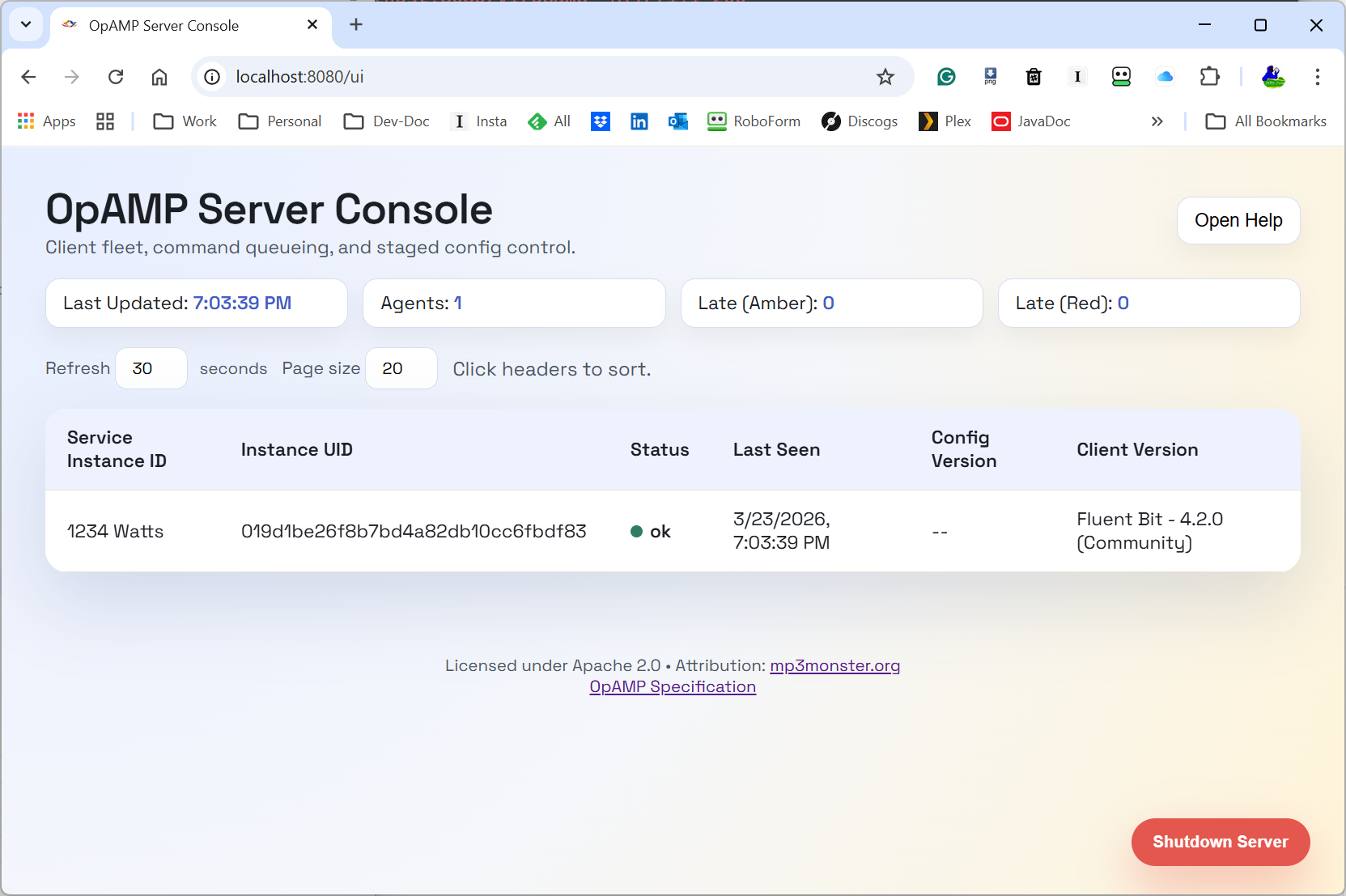
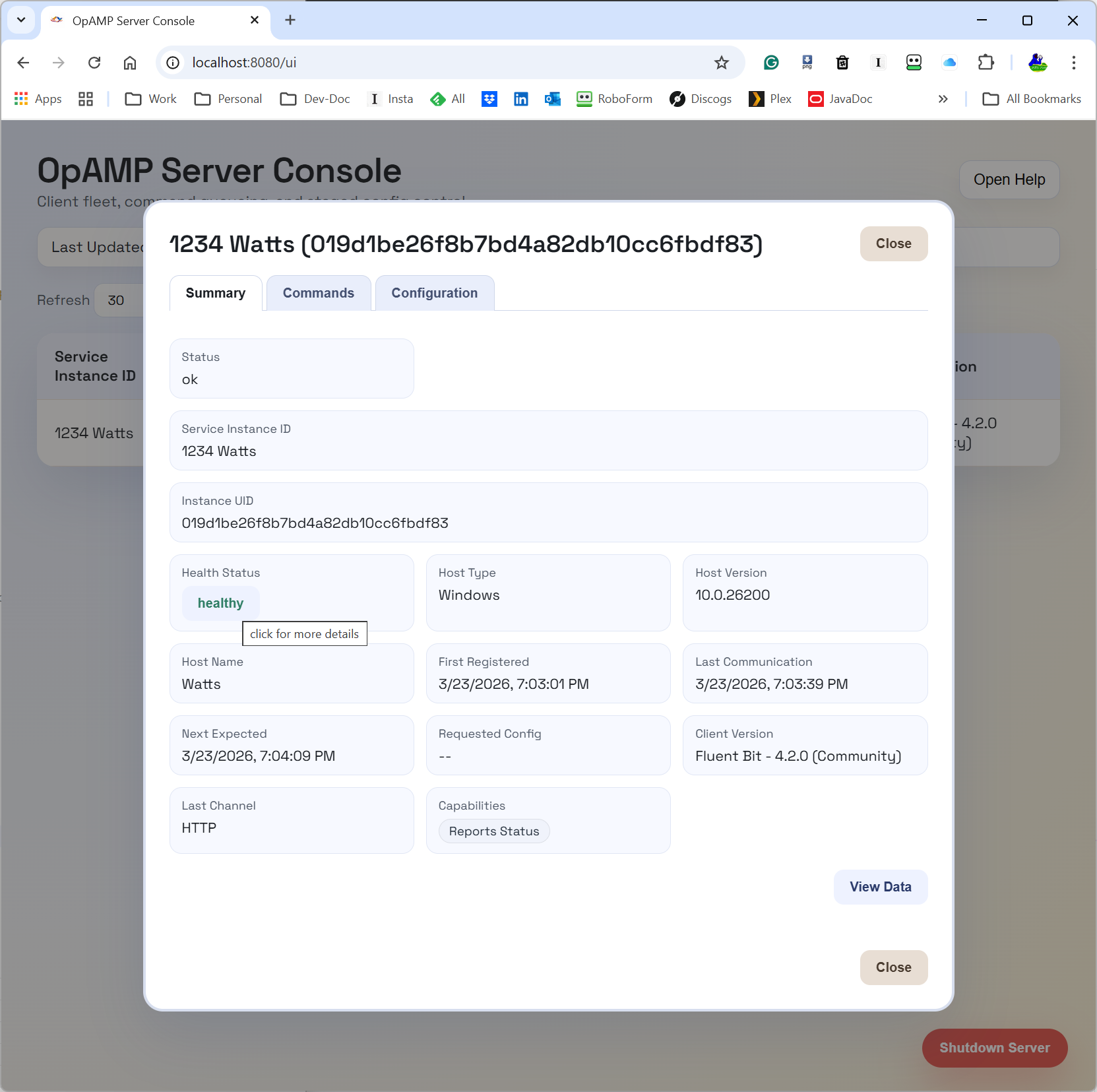
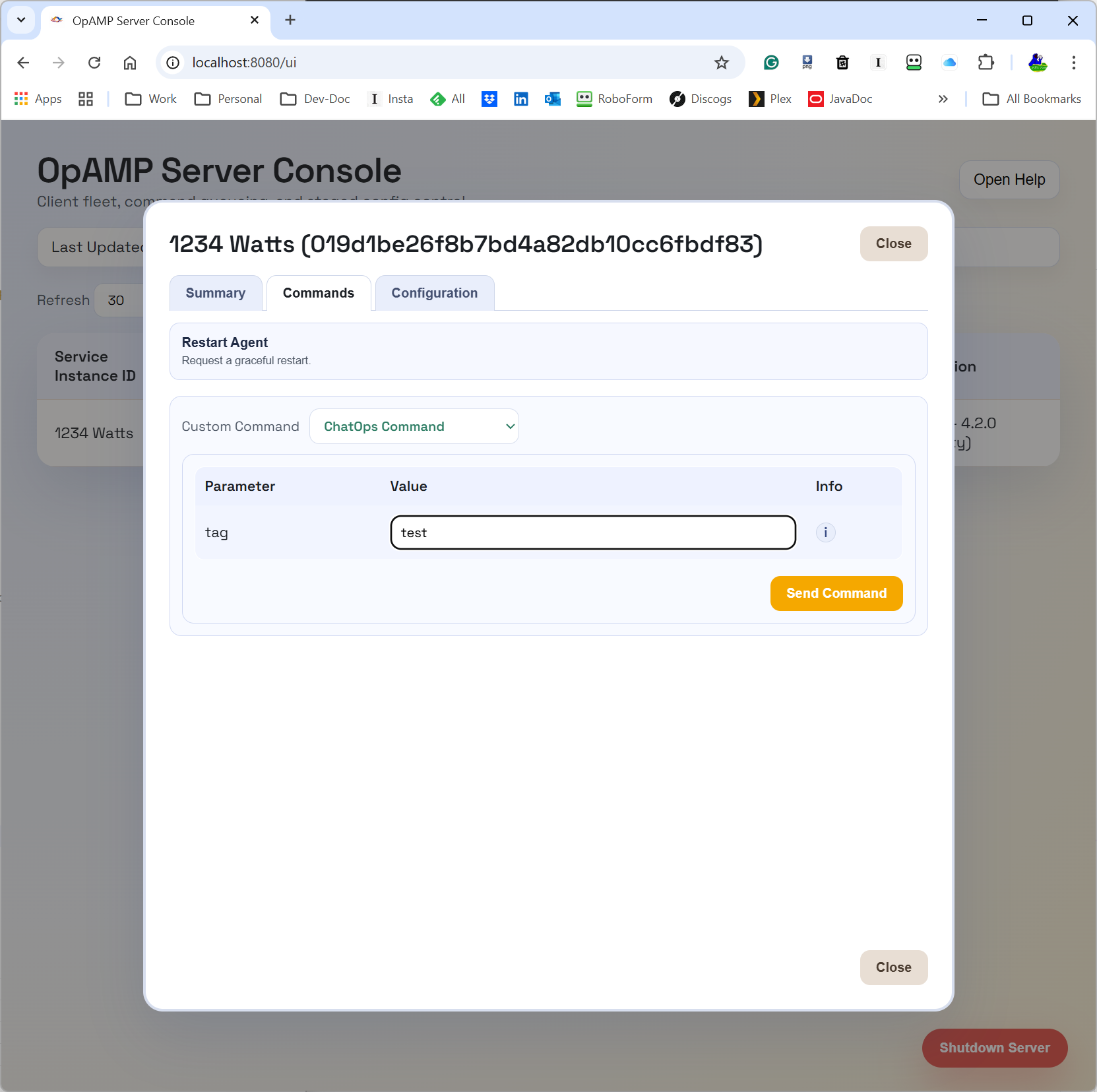
The UI is still evolving, but this gives a concrete picture of the provider side control plane we are discussing.
The provider is responsible for the shared view of fleet state and intent.
Today it provides:
/v1/opamp) over HTTP and WebSocket.Operationally, this means we can queue intent once at the server and let the next client poll/connection cycle deliver that action in protocol-native form.
The supervisor is the practical glue between OpAMP and Fluent Bit:
AgentToServer messages (identity, capabilities, health/status context).ServerToAgent responses and dispatches commands.So for Fluent Bit specifically, the supervisor gives us a way to participate in OpAMP now, even before native in-agent OpAMP support is universal.
And to be explicit: this is the current target. Fluentd support is a planned evolution of this same model, not a separate rewrite.
ChatOps is where this gets interesting for day-2 operations.
In this implementation, ChatOps commands are carried as OpAMP custom messages (custom capability org.mp3monster.opamp_provider.chatopcommand). The provider queues the custom command, and the supervisor’s ChatOps handler executes it by calling a local HTTP endpoint on the configured chat_ops_port.
That gives us a cleaner control path:
This is a stronger pattern than directly letting chat tooling call every node individually, and it opens the door to better auditability and policy controls around who can trigger what.
This is important: we are still actively testing functionality.
Current status is intentionally mixed:
So treat this as a working framework with proven pieces, not a finished all-capabilities implementation.
docs/features.md)Near-term priorities include:
Broader roadmap themes include:
And yes, a key strategic direction is evolving the framework abstraction so it can support Fluentd in due course, not only Fluent Bit. Some feature areas (like package/status richness) make even more sense in that broader collector ecosystem.
OpAMP gives us a standard envelope for control-plane interactions; the server/supervisor split gives us pragmatic deployment flexibility; and ChatOps provides a human-friendly control surface.
Put together, this becomes a useful pattern for managing telemetry agents in real environments where fleets are mixed, rollout velocity matters, and “just redeploy everything” is not always an option.
If you are evaluating this right now, the right mindset is: useful today, promising for tomorrow, and still under active verification as we close feature gaps.


You must be logged in to post a comment.